

Late blight confirmed in second Michigan field
Potato late blight, first confirmed in a Michigan field on July 23, has been confirmed in an additional field in the same county on Aug. 5





Potato late blight, first confirmed in a Michigan field on July 23, has been confirmed in an additional field in the same county on Aug. 5.
The disease was noted on several plants on the northern edge of a commercial field in St. Joseph County, according to a report from Jamie Wilbur, assistant professor in Michigan State University’s Department of Plant, Soil and Microbial Sciences.
The genotype of the Phytophthora infestans pathogen was US-23, the same reported last month.
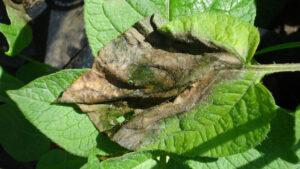
An example of late blight in a potato plant. Photo courtesy of Michigan Potato Industry Commission.
Sanitation and management measures are being applied and vine-kill of the entire field will begin as soon as weather conditions permit, according to the report. US-23 can typically be managed with phenylamide fungicides including mefenoxam and metalaxyl.
Preventative foliar programs and diligent crop monitoring are strongly recommended.
The MSU report acknowledged Rob Schafer of Mid-Michigan Agronomy for reporting the detection.
Current late blight risk is generally medium in Michigan. Late blight forecasting for the Upper Midwest is available through the University of Wisconsin-Madison’s Vegetable Disease & Insect Forecasting Network.
Following July 3 and 5 reports from Elgin and Kent Counties in Ontario, Eugenia Banks reported an additional detection in Simcoe County, Ontario on July 10.
On July 29 a report was released of molecular detection of P. infestans sporangia in Grand Falls, New Brunswick from Kutay Ozturk, assistant Extension professor at the University of Maine.
One late blight spore was reported in a spore trap, according to Ozturk. No late blight was detected in foliage.
No Phytophthora infestans DNA has been detected from experimental spore samplers maintained by the MSU Potato and Sugar Beet Pathology program, currently deployed in research and commercial fields in Montcalm County.