

Palmer amaranth confirmed in North Dakota





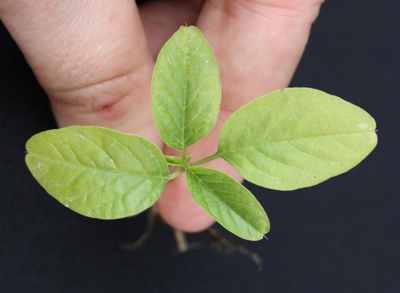
“A diligent farmer was scouting his field and doing some hand-weeding when he came across plants that looked unusual and wondered if they could be Palmer amaranth,” said NDSU weed scientist Brian Jenks.

Palmer amaranth seedlings have egg-shaped leaves with a hair-like protusion at the leaf tip (Photo source: Christy Sprague, Michigan State University)
The farmer pulled the plants to keep them from going to seed, Extension said. He showed the plants to a local agronomist, who contacted NDSU weed specialists for confirmation.
The plant in McIntosh County likely came from seeds dropped by migratory birds, according to NDSU Extension sugar beet agronomist Tom Peters.
NDSU Extension said that Palmer amaranth is the top weed problem in the U.S. and is a type of pigweed that originated in the desert region of the southwestern U.S. (New Mexico and Arizona and northern Mexico, then spread to the Mississippi Delta before invading Missouri, Kansas, Iowa, Wisconsin, Minnesota and South Dakota, as well as other states.)
NDSU Extension Palmer amaranth facts
Palmer amaranth is extremely hard to control because it is prone to being resistant to several herbicides. Applying herbicides before the weed emerges is more effective than trying to control it with herbicides after it has started growing, Peters said.
Unlike other annual weeds that need to be controlled only through early summer, Palmer amaranth emerges throughout the growing season, notes Jenks. Peters and Jenks say the best way to keep Palmer amaranth from spreading is to look for it.
Identifying Palmer amaranth can be difficult because it resembles redroot pigweed, Powell amaranth and waterhemp. One of the best ways to distinguish Palmer amaranth from the other weeds is its leaf stem, or petiole, Peters said. Palmer amaranth’s petiole is as long as or longer than the leaf blade.
Another clue is Palmer amaranth’s distinctive, long, snaky seed heads. The seed heads can grow up to 2 feet long. NDSU Extension’s Palmer amaranth website has more information about the weed and how to identify it.
Farm equipment, wildlife, water and wind are among the ways Palmer amaranth seeds can spread. In other states, seeds also have been found in native seed mixes used for pollinator or wildlife habitats and in potting soil and hay. A lot of donated hay came into North Dakota in 2017 because of the severe drought the state was experiencing, so producers need to be on the lookout for Palmer amaranth and other weeds, Jenks and Peters said.
Gardeners also need to keep in mind that the potting soil they buy in North Dakota likely was bagged elsewhere and it may contain contaminants such as Palmer amaranth seeds, Peters said.
Anyone who sees a plant that may be Palmer amaranth should contact a local NDSU Extension agent as soon as possible. Visit https://protect-us.mimecast.com/s/OajfC2kJD4fOBOXCvhls-?domain=ag.ndsu.edu for contact information.
“This weed is a game changer and will be controlled only by a zero-tolerance policy,” Jenks said.