

Michigan Upper Peninsula variety trial results released





Michigan State University (MSU) Extension conducts multi-location field trials every year to evaluate new potato varieties. The Upper Peninsula location for trials was at TJJ Farms in Cornell, Michigan, operated by Tony and Joe VanDamme. In 2016, 32 different varieties of red, russet and yellow tuber types were planted and compared to industry stand varieties. In the field trial, every variety was sized according to the tuber type, evaluated for yield and quality, and were rated for vine vigor and maturity.
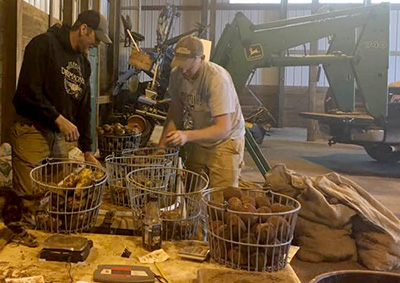
Photos: Monica Jean/MSU Extension
The potato trial was planted May 24 and harvested Oct. 3. The region gained two weeks in heat accumulation compared to previous years with a growing degree-day (GDD) accumulation for base 40 degrees Fahrenheit of 2,762. Regional rainfall beginning in April accumulated 19.5 inches, compared to the five-year average of 17.8 inches. This growing season has been moderately successful for potato farmers with a one-to-two-week earlier-than-normal harvest and good yields.
The results of the variety trial were on par with farmers’ results for yield and quality. The Dakota Ruby, a dark red skinned variety with bright white flesh, yielded 362 cwt/a US#1 with 67 percent A and 31 percent B size tubers. With a specific gravity of 1.078 and good sizing, the Dakota Ruby would be a good variety for table use. The top three russet varieties all yielded around 500 cwt/a US#1 and above, with ND050032-4Rus yielding 542 cwt/a US#1. Specific gravity ranged from 1.085-1.087, possibly making these varieties good candidates for French fry production. A06862-18VRRus had a very vigorous vine with early emergence and late maturity.
The top two yellow varieties were Soraya and Julinka, yielding 462 and 440 cwt/a US#1, respectfully. Specific gravities on these varieties were in an acceptable range for table use. Soraya had a high percentage of oversized potatoes and may benefit from a closer in-row spacing in order to reduce the overall tuber size profile. Internal tuber quality was excellent for all of the varieties with no hollow heart or discoloration noted.
Variety trials are used as a stepping stone for farmers by informing them on variety success in their local area. They can then use this information in their decision-making process when choosing varieties for larger scale production. By pinpointing successful varieties within a growing region, we are able to move towards commercial production while maintaining quality and yield. Some of the top varieties noted here will go on to a larger scale planting next growing season.
For questions, email Monica Jean, MSU Extension educator, at atkinmon@anr.msu.edu. For more information, visit www.msue.msu.edu.
— Monica Jean, Michigan State University Extension
Source: Michigan State University