

Yield, resistance key considerations in quest for new varieties
Michigan State University (MSU) is testing almost 200 advanced breeding lines in its potato breeding program





As a participant in the National Chip Processing Trials run by Potatoes USA, the program is also evaluating 300 to 400 lines this year.
Indoor research — including tissue culture and DNA marker analysis and greenhouse-certified seed production — is critical for developing improved varieties. Ultimately, field trials and the data collected from them are the deciding factors in whether a variety makes it into production.
A PAINSTAKING PROCESS
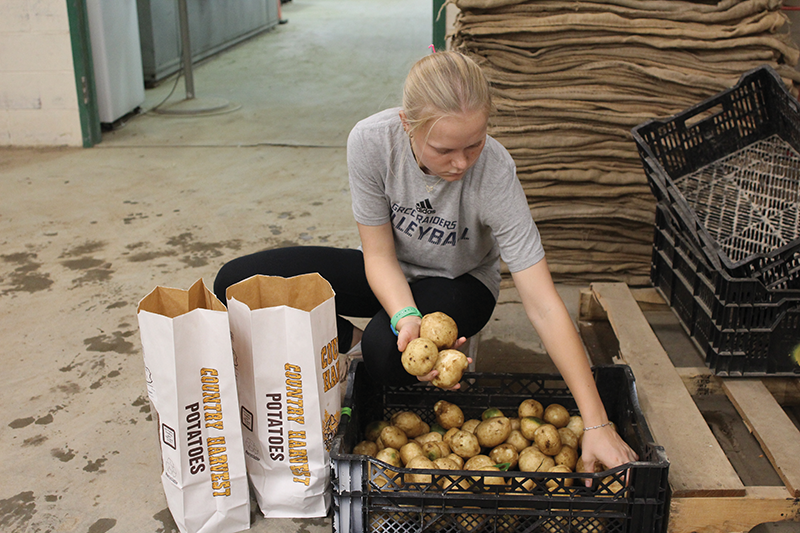
A key part of data collection occurs at MSU’s potato storage facility, where the potatoes are graded after harvest. Potatoes are washed and measured for yield, bruising, disease and specific gravity, and then chipping is done.Much of the sorting, weighing and data compilation is automated.

Much of the sorting, weighing and data compilation of the newly harvested potatoes is automated. This enables MSU researchers to be more efficient, collect stronger data and make better decisions. Photos by Dean Peterson.
Potatoes with growth cracks, off shape or knobs, along with oversized and small potatoes, are sorted on the grading line and weighed. Marketable potatoes are sorted into larger and smaller sizes. The goal is to calculate a marketable weight so the varieties in a specific trial can be ranked according to yield.
Researchers also tumble the potatoes to simulate bruising so the varieties can be ranked on bruise susceptibility.
Some measurements, like the amount of potato scab, are visually assessed on the grading line.
“Soil pathogens are very hard to quantify,” Douches said.
At many sites, the soil is not uniform in the amount of disease present. A variety may show good scab tolerance in some fields but can field test poorly at a site that has large amounts of the pathogen. Hence, it can take a few years to select for tolerance because a variety may not show consistent resistance or susceptibility.
“We feel we’re making good progress on scab tolerance in Michigan,” Douches said. “We have sites where we can select for scab tolerance consistently.”
A point of discussion that sometimes emerges in plant breeding is the need to select for short-term genetic gain while maintaining genetic variance for the long-term. The concern is overemphasizing one trait could edge other desirable traits out of the gene pool.
“I don’t think we’re breeding for the short term,” Douches said. “We’re developing widely adapted varieties because that’s what the chip industry needs. We want to have wide diversity in our parent material and broad adaptability in our varieties.”
HARNESSING NEW TECHNOLOGY
Emerging technologies have improved the selection process. Genomic selection is a strategy used to predict the measurable traits of plants. It compares a plant’s genetics to the plant’s physical appearance to build a predictive model. This increases a breeding program’s capacity to evaluate new varieties and reduces the time needed to develop them.“Genomic selection makes plant breeding more efficient,” Douches said.

MSU is testing almost 200 advanced breeding lines in its potato breeding program, said David Douches, director of the university’s Potato Breeding and Genetics Program.
Another new technology is the ability to silence or suppress an undesirable gene. Research findings on how to manipulate the gene that produces vacuolar acid invertase in potatoes led to MSU’s development of the Kal91.3 variety.
Developed from MSU’s existing potato variety Kalkaska, Kal91.3 can be stored for long periods of time without sucrose being converted to fructose and glucose. This minimizes off-color browning and caramelization.
“Developing new varieties takes teamwork between the university, the processor and the grower,” Douches said. “Processors want good processing features, growers want good yield, and I also try to add a degree of disease resistance.”
The key is growers and processors working together toward similar goals.
“There is good communication between growers and processors,” Douches said. “They’re both open to new varieties. As the plant breeder, it’s my role to identify those lines that are the best benefit to both.”