






Turning fiber into fashion
Emerging technology from the United Kingdom gives value to every part of the potato plant, turning stems and leaves into a new kind of sustainable textile fabric.
Fibe has already caught the attention of fashion brands in Europe and North America and is supported by Tin Shed Ventures, Patagonia’s venture capital fund.
Its implications, however, reach well beyond the runway.
For the food and processing industries, Fibe’s approach represents an opportunity to capture value from material that has long gone to waste.

FROM FIELD TO FIBER
Each year, millions of tonnes (one tonne equals a metric ton, or 2,205 pounds) of potato plant matter — mainly stems and leaves — are left to decompose in the field after harvest. These residues have little economic value to the farmer and are often plowed under. Now that waste may have additional value.
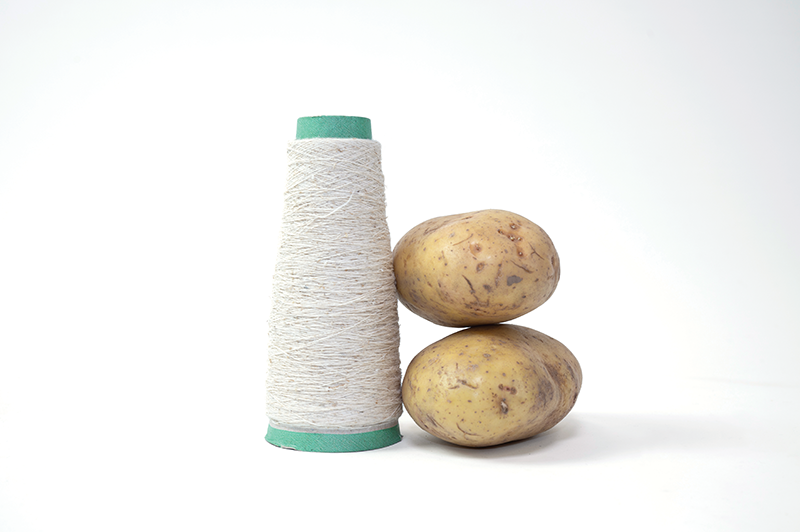
Using a patent-pending process, Fibe — founded in 2022 by four design engineers from Imperial College London — extracts and transforms plant material into a natural fiber suitable for spinning and weaving. Internal numbers show the process is more sustainable than conventional cotton production as it uses 99.7% less water and generates 82% less CO₂ emissions. The result is a biodegradable, compostable and recyclable textile that can be blended with other natural fibers without compromising strength or quality.
While the result is positive news for the textile industry, waste-to-fiber processes still face challenges. Fibe CEO Idan Gal-Shohet highlighted subpar quality, complex processing and material sourcing as issues the company has overcome.
Fibers from waste streams tend to be short and weak, a challenge overcome through novel bioprocessing and proprietary machinery that is more delicate than existing processes but still able to produce soft, high-quality fibers, Gal-Shohet said.
Conventional fibers like hemp and linen can take weeks to go from plant to fiber and require know-how and craftsmanship to understand when the stems are ready to be processed. Fibe automates that process, speeding the plant-to-fiber transition to less than a day with fewer steps, Gal-Shohet said.
The last key challenge Fibe is working to overcome is collecting material at scale.
“Our ability to work with potatoes as well as other crops means we can quickly pivot to the most available materials in a region,” Gal-Shohet said.
CLOSING THE CIRCLE FOR PROCESSORS
AND GROWERS
In the context of a global shift toward sustainability and circular production, Fibe’s innovation fits within the goals of both the agricultural and fashion sectors. What sets it apart, though, is its potential to create cross-industry partnerships, particularly between the fashion industry and food processors.
Potato processors and packers routinely handle large volumes of raw material, generating residues and by-products that might otherwise be discarded. If those residues could become a feedstock for textile production, they could offer processors and growers a new revenue stream while reducing overall waste.
“As we scale, we continue to explore both off-the-shelf and proprietary machinery that allow us to collect the stems from the farmer in an automated way,” Gal-Shohet said. “Importantly, we seek not to add any steps to the harvesting process and slot it directly into farming practices.”
Currently, Fibe sources potato residue from its U.K. network. The bulk of this year’s material has been gathered through the company’s collaboration with harvesting technology company GRIMME to develop a new potato harvester.
“Due to the larger scale of farming practices in North America, we will focus on leveraging relationships with the biggest potato growers and processors in the region,” said Jacob Smith, Fibe’s head of agriculture. “This would provide us direct integration into the strong growers’ network within a high-production area such as Idaho and Washington in the Northwest of the USA, and into Canada.”
EXPANDING APPLICATIONS AND
FUTURE MARKETS
While Fibe’s early partnerships focused on fashion textiles, the company is now exploring opportunities beyond clothing. Potential applications include home furnishings, upholstery and automotive interiors.
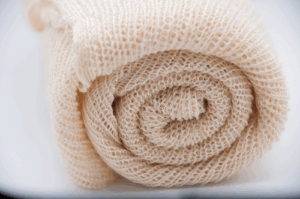
Currently, the company’s fibers are similar to cotton or linen, which allows them to go into knits, canvas, denim and woven fabrics.
“The most promising sector remains the textile industry as there is the largest amount of funding and experience in bringing novel textiles to the market,” said Gal-Shohet, who added that agriculture and textile industries often operate in the same regions. “We are still (in) early stages, and we have yet to explore many use cases.”
Scaling production, however, will depend on logistics, consistent supply and clear value-sharing along the chain. These factors could determine whether agricultural by-products such as potato leaves and stems become a new commodity rather than a waste burden.
As the company strengthens its partnerships with brands and explores international sourcing, its technology could also open a new market channel for America’s potato industry.
“The demand for high-quality fibers is increasing as brands struggle to meet growing global demand,” Gal-Shohet said. “This makes an additional sustainable fiber market highly valuable.
“This value can be spread down the supply chain … to growers, who would be able to sell their by-products and generate a supplementary revenue stream.”