

How to make the right choice between single and dual wicketed baggers
An industry expert shares insights on how to choose the correct configuration for a production line.





Choosing between a single wicketed bagger (SWB) and a dual wicketed bagger (DWB) is one of the most important decisions a produce packer can make.
Get it right and your line runs efficiently for years. Get it wrong and you’re either leaving throughput on the table or over-investing in capacity you don’t need.
Noah Fox, project manager at Fox Solutions, shared insight on how to think through this decision.
Starting with speed
The most fundamental question is bags per minute. Fox said the threshold is relatively clear:
“A DWB becomes the better option when the person packing bags is trying to do above 25 bags per minute,” he said. “Of course, that answer changes depending on the bag size. For a larger weight bag, that threshold would be lower. For example, with a 5-pound bag, that threshold would be if you want to be above 18-20 bags per minute.”
For operations that don’t need to push those numbers, the single bagger often makes more sense, for reasons beyond cost.
“A SWB makes more sense when speed, i.e. bags per minute, is not a top priority,” Fox said. “If consistency is more important, then the SWB is a better option because operators have only one bag head to manage. This means that they are more focused on what is happening to that machine and can catch issues before they slow down production.”
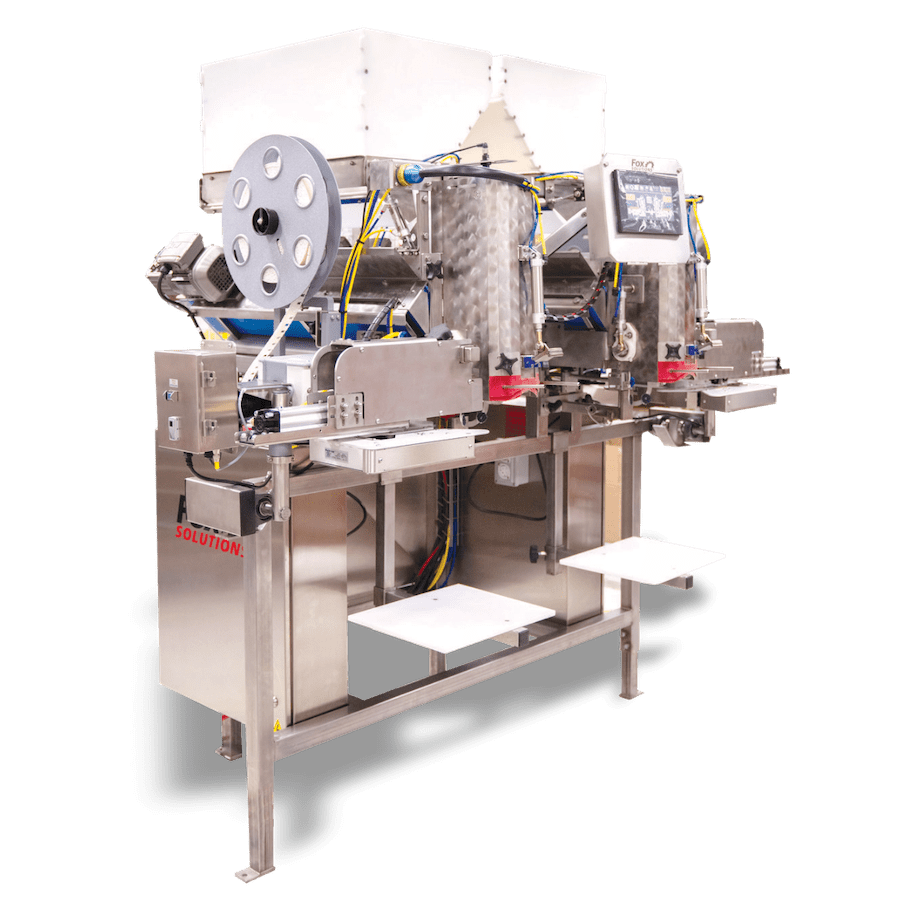
A dual wicketed bagger can be a better option for a packer concerned with speed, trying to pack more than 25 bags per minute. Photos courtesy of Fox Packaging and Fox Solutions.
Factors driving decision to upgrade
When operations do make the move from single to dual, it’s rarely just one factor driving that decision. Fox said throughput and labor savings dominate the conversation, and the math behind a DWB tends to be compelling.
“Throughput increases exponentially from handpacking and basically doubles from a SWB. Because of the increased throughput, the ROI on a DWB is typically better,” Fox said. “And since the throughput is roughly double, with a DWB, the labor cost reduction per unit is also double.”
Price, he noted, usually comes third on the decider list. Producers chasing higher throughput numbers tend not to be price-shy. But for earlier-stage operations, Fox said the SWB offers a different kind of value.
“Customers who are in an earlier growth stage find the SWB to be the best option — not only because of the cost savings, but the SWB is also a great entry-level bagger,” Fox said. “It is simple enough in design and operation that you do not need much experience with automated baggers. Additionally, it is versatile enough that once it becomes time to expand, it can be paired with another single to create a DWB.”
A real-world example
Fox Solutions worked with fresh produce distributor Tanimura & Antle in Hollister, California, integrating Fox wicketed baggers with a Newtec 4014 weigher and QC-90 checkweigher. The company, with products including fresh and organic lettuce, celery and cauliflower, achieved concrete results.
The system averaged around 60 bags per minute on 5- to 10-pound bags, and the operation shifted from a six-day work week down to four days, achieving a 33% reduction in labor hours without sacrificing throughput.
Automated weighing also addressed a persistent problem on the floor. Workers used to individually weigh bags by hand, a time-consuming process that led to product overfill. With the checkweigher integrated into the line, product giveaway dropped, reducing waste and improving profitability in one move.
When Tanimura & Antle added its first pair of dual baggers, the impact was immediate.
“They eliminated the need for an entire shift and six-day work weeks,” Fox said. “They followed up with another matching set up that increased their throughput to somewhere between 120 to 140 bags per minute.”
Not every application is about maximizing throughput. Fox Solutions also worked with the Tarrant Area Food Bank, where the challenge wasn’t speed. It was finding consistent labor to hand-pack at all.
“For them, speed was not a huge concern,” Fox said. “They needed a solution to combat the difficulties they were encountering finding volunteers to hand pack. Moreover, they decided to go with a V-belt style because they are packing a variety of products.”
V-belt vs. flat belt
Beyond single versus dual, the belt configuration is its own decision, and it’s almost entirely driven by what you’re packing.
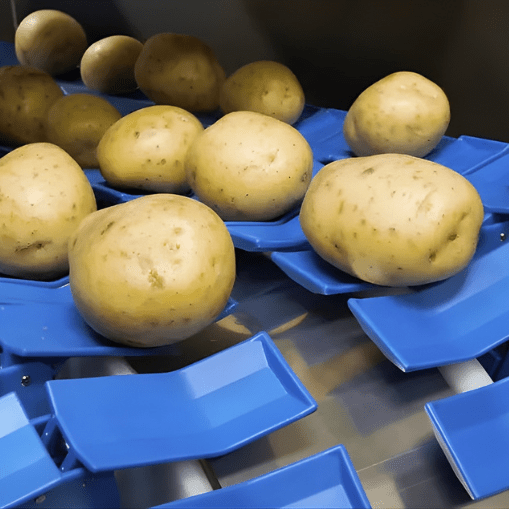
“Smaller round commodities that won’t bunch up are great for the flat belt,” Fox said. “Meanwhile, larger, irregularly shaped products will work much better on the V-belt style system. When product sizes get larger and bag weights get heavier, singulation is important.
“If you try to pile everything down the chute and into the bag, you will cause bridging, and then you will stop production.”
For products like russet potatoes, the V-belt does more than prevent jams. It actually orients the product.
Fox noted that it helps turn oblong items so that either the stem or bud end leads the way into the bag, which contributes to a cleaner, more consistent fill.
An overlooked factor
Fox said there is one factor customers most often miss when making equipment decisions.
“Oftentimes, the potential yield is overlooked for the average yield,” he said. “In produce, nothing is guaranteed, so usually we all work on averages. For the most part this works out and there are no issues.
“However, if you purchase equipment based on the average yield and then end up with a bumper crop, the equipment will not operate to the rate that is required.
“This is why, if a customer is on the fence, we always recommend going up to the DWB.”
There are also physical considerations that get missed during the planning phase, with roof clearance being one of the most common.
“By the time you raise the weigher up over the bagger you are already around 12 feet. This is often an afterthought,” Fox said. “Additionally, drop locations for power and air are often forgotten, especially if they are not preexisting.”
Uptime and remote support
One operational advantage that applies equally to both configurations is remote diagnostics.
Fox Solutions connects baggers to a network, enabling technicians to troubleshoot and course-correct without being on-site.
“When our technicians and programmers have the ability to remote into machines, we can diagnose problems and course-correct without having to be on site,” Fox said. “This means the customer does not have to pay for a service call; at most they will have to purchase parts.
“This also has a positive effect on maintenance crews. They get to be more hands on with the equipment instead of someone else doing the work for them.”
The right bagger isn’t always the fastest one or the most expensive one, Fox said. It’s the one that matches a processor’s volume, product, crew and growth plan.
Noah Fox is product manager for Fox Solutions.