

Research digs into nitrate leaching
Wisconsin work investigating how soil processes impact nitrogen fertilizer





Wisconsin work investigating how soil processes impact nitrogen fertilizer
Producing top yields while minimizing nitrate leaching to groundwater is a challenge for potato growers across the country.
This is especially a concern in areas like Wisconsin’s Central Sands, an area of potato and intensive vegetable production. The poor water-holding capacity of coarse-textured soils and high nitrogen requirements of these crops make nitrate leaching to groundwater a serious concern.
Recent studies show about 10% of Wisconsin’s rural wells contain enough nitrate to exceed safe levels. Efforts such as Wisconsin’s Nitrogen Optimization Pilot Program (NOPP) and new research from the University of Wisconsin are working on solutions.
DIGGING INTO RESEARCH
The University of Wisconsin research compared four treatments of nitrogen fertilizer at a rate of 250 pounds of actual nitrogen per acre to a control without nitrogen fertilizer.
The treatments were ammonium sulfate plus ammonium nitrate, polymer-coated urea, urea with a urease inhibitor, and urea with a urease inhibitor plus a nitrification inhibitor.
Polymer-coated urea is a urea granule coated with a polymer that slows the release of nitrogen into the soil. Urease is an enzyme in the soil that converts urea to ammonia gas, which is lost to the atmosphere. Nitrification is the conversion of ammonium nitrogen to nitrate nitrogen, which can then leach or be denitrified and also lost to the atmosphere.
Both urease’s conversion of urea to ammonia gas and nitrification are microbial processes. Urease and nitrification inhibitors slow these processes. The processes are also heavily temperature- and moisture-dependent.
The research results were also heavily weather-dependent. Polymer-coated urea reduced nitrate leaching and increased yield in years with large amounts of early season rainfall.

“We’ve seen some real success with polymer-coated urea,” said Matt Ruark, professor and Extension soil scientist in the University of Wisconsin’s Department of Soil and Environmental Sciences. “The tricky part with polymer-coated urea is to manage it so it’s economical.”
Polymer-coated urea was less effective at reducing leaching later in the season
and in years with less rainfall. In years with less intense rainfall events, there also wasn’t any difference in leaching between the four fertilizer treatments.
“A lot of additional work needs to be done with rates and timings,” Ruark said. “How efficient can we be on a crop like potatoes? Can we quantify the need? Can we be more efficient if we spoon-feed the crop?”
NITROGEN NUMBERS
Monica Schauer, a researcher in the University of Wisconsin’s Nutrient Cycling and Agroecosystems Lab and NOPP research director, said greater efficiency lowers cost for growers and reduces leaching.
“Greater efficiency is a win-win,” she said.
The NOPP is state-funded and supports farmers in on-farm research trials to improve nitrogen use and protect groundwater.
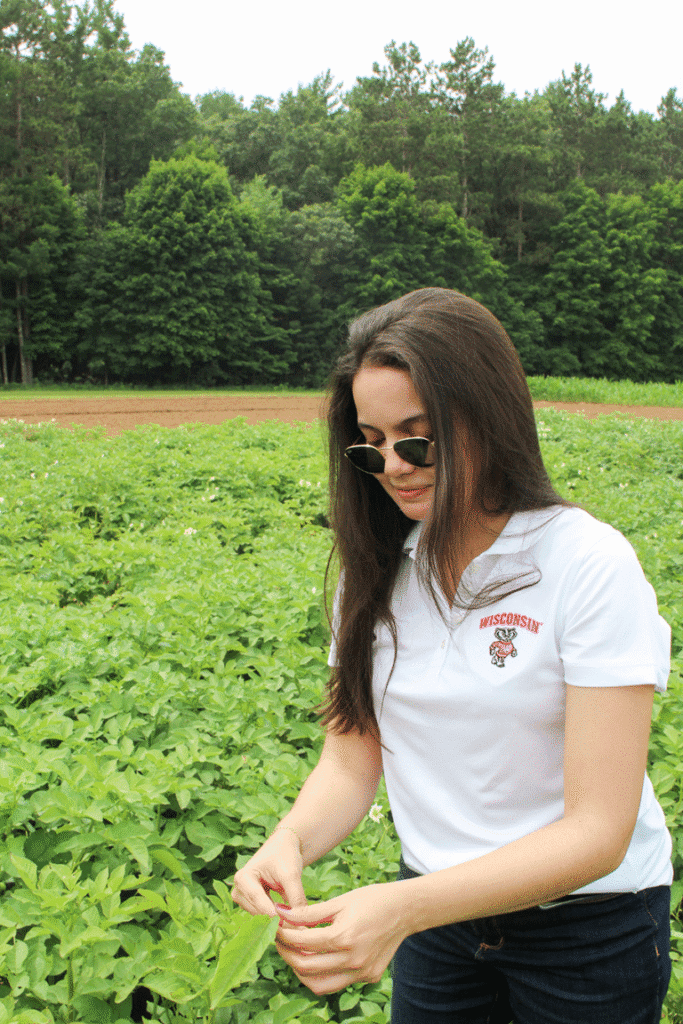
“This is a really important issue,” said Larissa Correia, another researcher in the University of Wisconsin’s Nutrient Cycling and Agroecosystems Lab. “Growers want to increase yield, but they’re also very concerned about the environment.”
The key, she said, is finding a balance.
Part of the issue is the way potato plants grow. They don’t start taking up large amounts of nitrogen until tuber initiation — two to three weeks after emergence. The plants also use very little nitrogen after 80 days past emergence.
The University of Wisconsin research confirmed that overall, the amount of nitrogen removed by the crop and the amount lost to in-season leaching was lower than the amount applied. This suggests significant amounts of nitrate leaching outside of the growing season.
CREDIT CALCULATION
Fall cover crops can take up some of this soil nitrate at the end of the season, but how much will that benefit next year’s crop? A cover crop terminated later in the season has more growth than a cover crop terminated earlier.
How does that affect the amount of nitrogen credits?
“Counting credits isn’t simple,” Schauer said. “It’s very complicated. There are lots of variables. And, we don’t have much evidence that a cover crop like rye will supply nitrogen to the next crop.”
Totaling the nitrogen credits available from all sources of nitrogen to most accurately determine a nitrogen fertilizer rate is often stated as a goal. Credits come from nitrate in irrigation water, nitrate released from soil organic matter, cover crops and other sources.
Failing to include the credits can lead to overfertilization and greater risk of nitrate leaching.
“How much background nitrogen is there?” Ruark asked. “There’s been a lot of work on it, but it’s tricky to figure out. There’s been a lot of grower support for this work on nitrate leaching, but we need more on-farm trials.”
Schauer suggests growers should consider which factors are controllable and which ones are not.
“Cover crops are a controllable factor,” Schauer said, while rainfall and temperature aren’t. “It’s combining management factors with environmental factors. It’s trying to find a balance between the need for high yields and the need to reduce nitrate leaching.
“Growers recognize the problem. There’s a lot of creativity in using nitrogen more efficiently. New products are continually coming on the market. Growers are willing to try everything to see what works.”