

New tools emerge in fight against common pest as neonicotinoids lose effectiveness
Colorado potato beetle is showing increasing resistance to neonicotinoids in the eastern and central U.S. New weapons in the ongoing battle show promise.





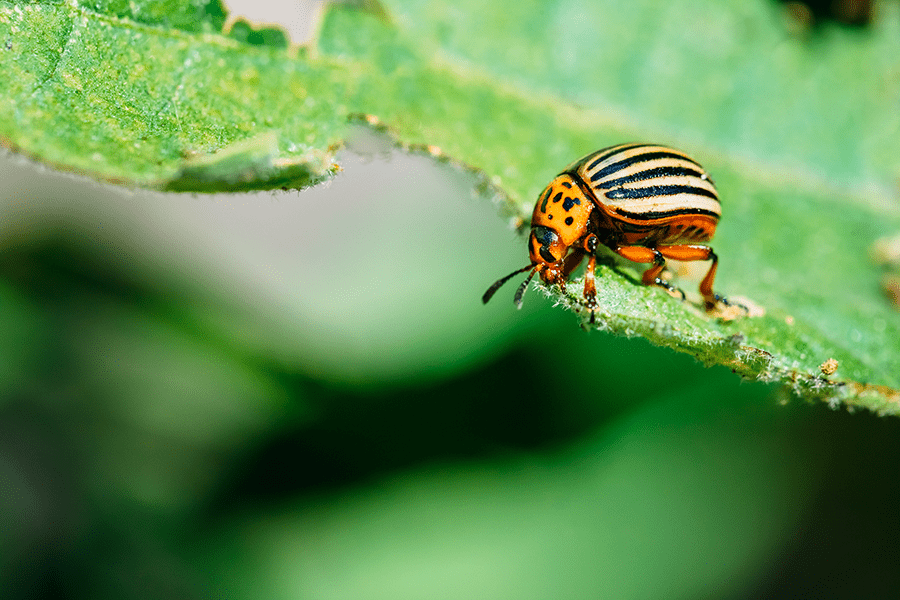
Two industry standards for controlling first-generation Colorado potato beetles are both systemic and effective. Thiamethoxam is applied in-furrow or as a seed treatment and sold in products such as Platinum or Cruiser. Imidacloprid, sold in products such as Admire Pro, is a soil treatment applied at planting.
The two treatments have something else in common: They’re both neonicotinoids, and that’s becoming a problem.
Colorado potato beetle is showing increasing resistance to neonicotinoids in the eastern and central U.S. Neonicotinoids are also highly toxic to bees. Large grocers have adopted pollinator protection plans, while laws like New York’s Birds and Bees Protection Act — which will restrict neonicotinoid use as seed treatments on corn, soybeans and wheat in a few years — could be an indicator of what potato growers may someday face.
“Neonicotinoids are getting close scrutiny — both scientifically and publicly,” said Brian Nault, a professor in Cornell University’s Department of Entomology.
Neonicotinoid alternatives
There are alternatives to neonicotinoids for controlling first-generation Colorado potato beetle. Insecticide Verimark is not a neonicotinoid and can be used as a soil application or seed treatment.
“We’ve seen good results from it in our trials,” said Russ Groves, professor and Extension specialist in University of Wisconsin’s Department of Entomology.
Cost is an issue, but Verimark’s active ingredient, cyantraniliprole, will soon go off patent, which could bring the cost down.
Groves advised using Verimark at planting or using foliar applications of insecticides to control the first generation of pests.
“You don’t have to use a neonicotinoid every year,” Groves said. “There are other insecticides for well-timed control of Colorado potato beetle in the spring.”
Those strategies have been evaluated in research plots at Cornell University for two years. Although beetle counts were slightly higher in the Verimark program in one of two years, the damage and yield in both strategies were consistent with a neonicotinoid program in both years.
The strategies have also been tested at University of Wisconsin, University of Maine, Michigan State University and Washington State University. In 2026, Cornell researchers will evaluate the strategies on growers’ farms.
New weapons
New products registered for foliar control of Colorado potato beetle, like Calantha and Zivalgo, also have the potential to help.
Calantha is a bioinsecticide that can effectively manage first-generation pests with a new mode of action that specifically targets Colorado potato beetle without harming bees and natural enemies. Its active ingredient is a ribonucleic acid molecule called ledprona, which silences a gene necessary for protein production in Colorado potato beetles. Calantha, however, requires multiple applications.
Wisconsin research showed three applications over three successive weeks provided good suppression. The product is also not fast-acting, as the larvae first have to ingest it and then slowly die. It must be applied at the beginning of a new population. The threshold to initiate treatment is when 10% of the eggs have hatched.
Zivalgo, an insecticide with a new, non-systemic active ingredient, isocycloseram, is effective on Colorado potato beetle, Nault said. Within 12 to 24 hours of application, all feeding stops.
“Growers can treat the first generation and rotate to another insecticide class for the second,” he said.
Zivalgo, expected to be approved for use nationwide later this year, will likely require two applications about a week apart. Calantha is the first Group 35 insecticide, while Zivalgo is a Group 30. Neonicotinoid products all have a Group 4A mode of action.
Choosing the best approach
Selecting a foliar insecticide should start with buyer needs. It’s also important to understand that not all foliar insecticides function in the same way. They often target different stages of pest development, with some killing only larvae and others best-suited for perimeter treatment. Some foliar products are sold in combinations as a way to help manage resistance.
“For that to work, the products have to have the same efficacy over the same time period,” Groves said. “If any of them have a shorter window of control, you can generate cross resistance quickly. If you’re using a pre-mix, understand why.”
Neonicotinoid resistance has yet to be identified in much of the western U.S., and neonicotinoids continue to be the standard for controlling first-generation beetles.
“In the Columbia Basin, we have lots of insect pests besides Colorado potato beetle,” said Tim Waters, professor and regional vegetable Extension specialist at Washington State University.
That list includes spider mites, thrips and other hard-to-control species. What other secondary pests are present usually decides which foliar insecticide is used for the second generation of Colorado potato beetle.
“For second generation, we tell growers to be ready with a number of foliar options and look at what your other pests are,” Waters said.
Organic challenge
Organic potato growers in the northeastern U.S. are reporting emerging resistance to popular insecticide Entrust in Colorado potato beetle. Insecticides using the naturally occurring soil bacterium spinosad, Entrust’s active ingredient, have been available for decades, but inert ingredients in the products were not acceptable for organic production, Groves said.
Entrust is the first spinosad insecticide to be certified for organic production by the Organic Materials Review Institute (OMRI), and no other OMRI-certified alternatives work as well for Colorado potato beetle control.
The declining effectiveness of Entrust “is one of the biggest challenges for organic growers,” Nault said. “Organic growers really need another effective tool.”
Since Colorado potato beetles only move around a half mile after emergence in the spring, crop rotation and field location offer a possible mechanism of control, Grove said.
Alternative hosts like eggplant also have to be considered, while late planting — though unpopular — can also be an effective control, as Colorado potato beetle has evolved to synchronize emergence with potato crops, Groves said.
Delaying planting until late June or even July will produce shorter, lower-yielding plants but eliminate the first generation’s source of food.