

Laser weed control model trained on millions of images speeds adaption
Carbon Robotics has introduced what it calls a major step forward in AI-driven weed control: the Large Plant Model (LPM), a foundation model designed to detect and identify plants across crops, regions and growing conditions.





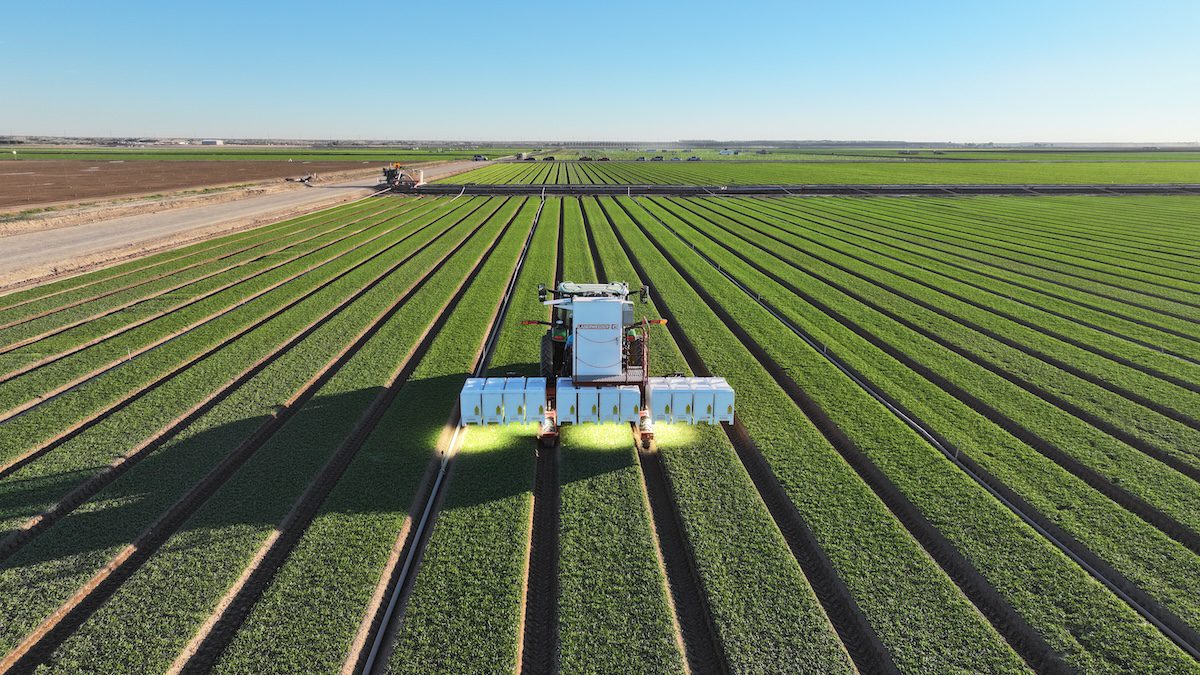
Carbon Robotics has introduced what it calls a major step forward in AI-driven weed control: the Large Plant Model (LPM), a foundation model designed to detect and identify plants across crops, regions and growing conditions.
The Seattle-based company said the LPM is trained on 150 million labeled plant images collected from more than 175 LaserWeeder units operating in over 100 crops across 15 countries. The goal is simple: allow growers to roll into a new field and begin laser weeding almost immediately, without weeks of retraining or calibration.
“This is a real innovation and step forward,” said Brett Goodwin, vice president of marketing at Carbon Robotics. “It’s a foundation model that understands the fundamental structure and feature vectors of different plants. You can take a LaserWeeder into a field or a crop it’s never been in before, and it will be able to identify weeds versus crops and begin weeding immediately.”
Foundation built on field data
Unlike traditional machine vision systems trained for a specific crop or environment, the LPM functions as a generalized plant-recognition engine. It continuously improves as LaserWeeder units operate in commercial fields worldwide, feeding new data back into the system. Carbon Robotics describes this as a compounding “data flywheel.” As more plants are seen and labeled, the model becomes more accurate and adaptable for all users.
“When our robots can understand any plant in any field immediately and adapt behavior in real time, farmers get maximum value from the machines,” said Paul Mikesell, founder and CEO of Carbon Robotics.
The LPM serves as the backbone of Carbon AI, the company’s broader decision-making system that powers its LaserWeeder line and Carbon ATK (Autonomous Tractor Kit). Carbon AI processes plant and field data to identify weeds, guide lasers, navigate terrain and adjust operations as conditions change.
Early stage advantage
One of the LaserWeeder’s defining capabilities is detecting weeds at early growth stages.
“One of the unique advantages of laser weeding is its ability to detect weeds that are as small as the tip of a ballpoint pen,” Goodwin said. “Right as your crop and your weeds are initially emerging, you’re able not only to detect them but also identify them and kill them before they’ve had a chance to compete.”
By eliminating competition early, growers can protect yield potential and reduce input costs.
“You see reductions in weed control costs, but more importantly, increases in yield quality and consistency because there’s absolutely no competition from the earliest outset,” Goodwin said.
The approach also addresses herbicide resistance, a growing concern in crops including potatoes.
“There’s no such thing as a weed that’s resistant to lasers,” Goodwin said. “We’re able to eliminate herbicide resistant weeds just as well.”
Reducing chemical reliance
Carbon Robotics positions laser weeding as a way to significantly reduce or eliminate post-emergent herbicide use.
“LaserWeeder can really replace all of your post-emerge chemical use,” Goodwin said. “Some of our customers will still put down a pre-emerge where it makes sense, but overall they’re able to dramatically reduce herbicide use, some of them to 100%.”
The implications extend beyond weed control costs. Goodwin noted growers may also see improvements in soil health when herbicide use declines.
“You’re able to treat weeds at a very early stage where maybe you’d be concerned about putting an herbicide on,” he said. “It results in greater soil health because the avoidance of herbicide leads to healthier biomes, healthier soils and less salinity in some cases.”
The technology appeals to both organic and conventional growers, particularly those seeking to lower input costs or manage resistant weeds.

growth stages, helping growers protect yield
potential and reduce input costs.
Tailoring AI to specific needs
A new feature called Plant Profiles builds on the LPM’s foundation by allowing growers to fine-tune the system for their specific fields.
“Every farmer will tell you there’s something unique about their farm — soil type, weed pressure, planting style,” Goodwin said. “Plant Profiles allows the farmer to tailor the model to those specifics.”
Using the iPad-based operator app, growers can select two or three images representing a specific weed or crop nuance. Those images are uploaded and incorporated into their tailored model.
“You just select a couple of images, press upload, and they immediately become part of your tailored AI model,” Goodwin said. “The LaserWeeder behavior changes immediately.”
Unlike some AI systems that require extensive image uploads and retraining cycles that can take weeks, Plant Profiles is designed for real-time adaptation.
“The word I’d really use is tailoring,” Goodwin said. “You’re taking something that’s already a good fit and tailoring it to your field specifics.”
Performance in variable conditions
The flagship LaserWeeder G2 is a 20-foot-wide implement capable of targeting up to 10,000 weeds per minute. It is equipped with 36 prediction and targeting cameras, high-intensity LED lighting and 24 NVIDIA GPUs.
“It’s basically like putting a mini supercomputer out in the field,” Goodwin said.
The system includes 24 high-powered lasers and automated speed control. As weed pressure changes, the machine can adjust tractor speed to maintain optimal performance.
“It will detect changes in weed pressure and automatically recommend speed changes up or down,” Goodwin said. “We have automated speed control that allows it to adjust in conjunction with that feedback.”
This responsiveness is particularly valuable in mixed weed populations, variable soils and rapidly changing field conditions.
For growers, performance ultimately comes down to return on investment. Carbon Robotics reports strong repeat purchases among customers.
“About a quarter of our customers who buy an initial LaserWeeder come back and buy a second one, oftentimes within the first year,” Goodwin said. “Our biggest fleets are six or seven LaserWeeders.”
Most units are designed to pay back initial investment in one to three years, according to the company. Savings stem from reduced weed control costs of up to 80% and improved crop quality.
“We generally see larger, more consistent, firmer product with better storability and higher grading percentages,” Goodwin said. “That applies whether it’s fresh market or processing.”
The technology is being used in a range of crops, including russet, red and yellow potatoes, as well as sweet potatoes.
“We’re having success with a lot of different people growing potatoes, both organic and conventional,” Goodwin said. “And many potato growers also grow onions or other crops. That’s perfect for LaserWeeder because you can switch from one crop to the next with just a simple click on the operator app.”
AI beyond weeding
The LPM also powers Carbon Robotics’ Autonomous Tractor Kit (ATK), which can be installed on existing John Deere 6 and 8 Series tractors. Equipped with cameras, lidar and radar, the system enables features such as furrow following and implement monitoring.
“Autonomous tractors will allow farmers to go day and night, weekends and holidays during key seasons,” he said. “You get higher utilization out of a smaller fleet of equipment and better return on your capital.”
If the system encounters an obstacle it cannot classify, it connects via Starlink internet to Carbon Robotics’ operations center, where staff can intervene remotely.
As growers look for tools that improve efficiency and consistency, Carbon Robotics is betting that large-scale AI models, trained on millions of real-world plant images, will play a central role in the future of weed management.