

Cultivating optimism: Growers focus on future while coping with concerns
The 2025-2026 Spud Sector Survey reveals how potato growers are balancing optimism with economic uncertainty. See more survey insights now.





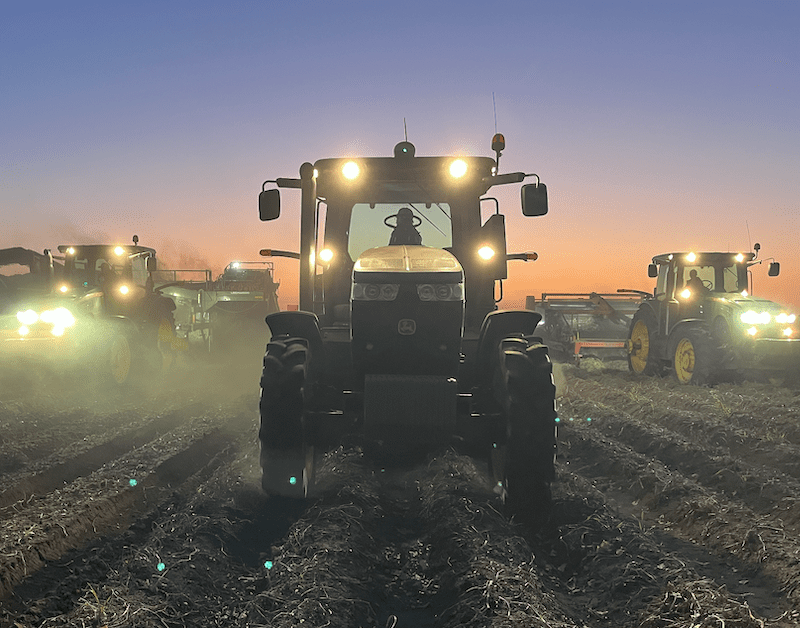
“September has been getting warmer and warmer the last few years, so we have been forced to harvest potatoes at night,” Dagen said. “We’ve gotten to be very good at it — harvesting in the dark. We have experienced some wonderful aurora borealis, so that’s one side benefit.”
Dagen, who grows 500 to 600 acres of certified seed potatoes at 107-year-old Dagen Heritage Farms, was one of 235 growers who responded to the 2025-2026 Spud Sector Survey, a joint effort by Great American Media Services and the National Potato Council to assess the pulse of the potato industry.
While 45% of respondents were optimistic about their farm’s performance in the year ahead, 44% were pessimistic about the U.S. potato industry, as were 55% regarding the greater U.S. agricultural industry.
Inflation and input costs drove growers’ concerns, with 65% of survey respondents citing those factors as their top challenges in the year ahead and 83% noting those areas as their top external worry. Participants also expressed concern about market price volatility and labor shortage and costs, with 38% flagging each of those as top-of-mind issues for 2026.
Those worries were mirrored in a breakdown of policy and international issues, with 68% ranking tariffs and trade barriers as their top concern and 54% choosing labor policy issues.

“The place we’re at now is actually a healthy part of the economic cycle of potato production,” said Dagen, who “was born in the 1950s” and has farmed his entire life. “From the demand side, our industry is in a pretty good place. We’re exporting 20% (of potatoes) from the United States and demand is rising for some segments of potato products, so I think we’re in a good place there. But we have experienced good, solid high-yielding crops the last two or three years, so that’s why we’re in the current spot, where the consumer is getting a very good value.”
Cost concerns
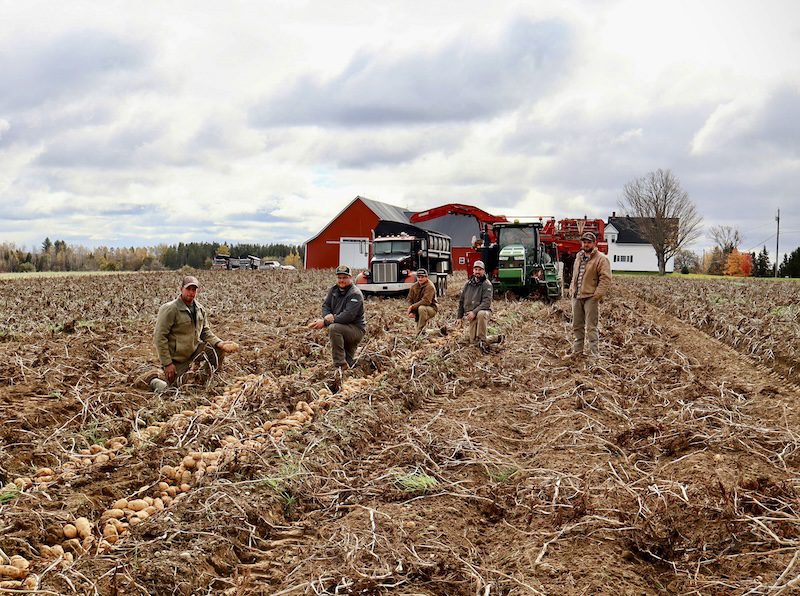
Garrett Hemphill of Hemphill Farms in Presque Isle, Maine, is fighting to stay optimistic even as he plants fewer acres in the face of declining contract volume and price for the second consecutive year.
“We grow for McCain and were told (Feb. 3) that our volume is going to be cut 10%,” Hemphill said. “But we have a fresh shed we work really closely with, so that’s been going pretty well this year. We do some new varieties for them.”
Hemphill grows 600 acres of potatoes — mainly for processing but also fresh, chipping and seed varieties — alongside his father and three younger brothers.
“It was my grandfather’s farm, and before that, it was my great-grandfather’s farm, and before that, it was my great-great-grandfather’s farm,” he said. “I live in the original farmhouse where we started. I’m fifth-generation. My kids are going to be sixth, hopefully.”
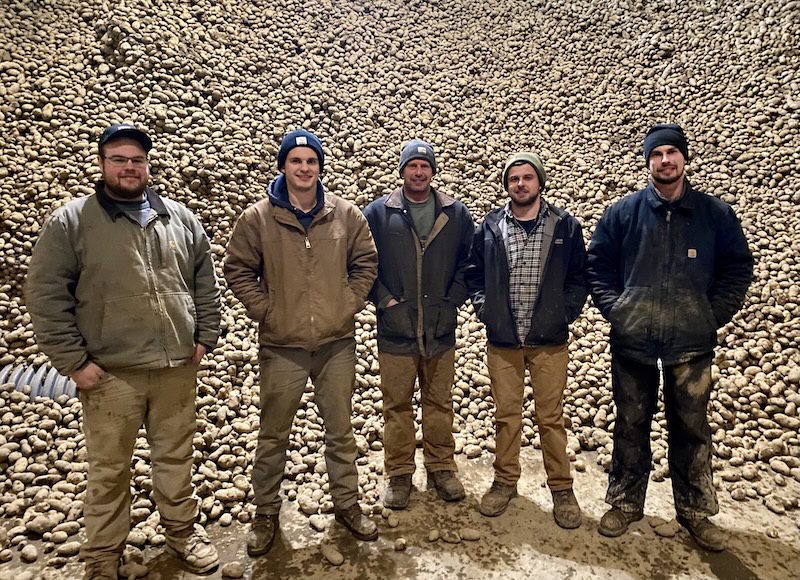
Growing 100 acres 15 years ago, the operation’s expansion was spurred by the acquisition of around 300 acres from Hemphill’s mother’s side of the family. Her brothers also grew potatoes until 2020, when they began providing malt for Maine breweries.

“That got so big that they stopped doing potatoes, and we took over the potato side of the operation,” Hemphill said. “Now we land-swap with them. They do all of our rotation crops, so we stopped doing grain the same year.”
Additional acreage has meant increasing input costs, from electricity to power storage sheds to fertilizer, Hemphill said. Just 10 miles from the Canadian border, Hemphill was initially worried about the turmoil created by fluctuating U.S. tariffs, but relieved to find most imports from his northern neighbor were covered by the U.S.-Canada-Mexico trade agreement.
Rising input costs are also a concern for Jeff Harper, who grows potatoes, corn, wheat and alfalfa on 4,000 to 5,000 acres at Flying H Farms in Mountain Home, Idaho. He’s also coping with shrinking contract price and volume while navigating uncertain trade terrain.
“It’s hard to do because you’re obligated to plant so many acres. If you get a great big yield, you have too many,” said Harper, who’s been farming for 45 years. “Obviously, we’ve never had the political system messing in the markets like we have right now. Then COVID has pushed costs to new levels.
“In agriculture right now, there’s no bright side to speak of, no crops that you can say ‘I can go over there and make money.’ They’re all slow.”
Proximity to dairy operations means ready access to phosphate- and potash-rich compost for Harper, “but it seems like anything that’s closely related to any type of energy source that requires natural gas or propane or electricity has gotten about 20% more expensive since COVID,” he said.
Carl Long, of Long Farms in Coudersport, Pennsylvania, has also felt the effects of topsy-turvy tariffs at his 3,000-acre operation, which produces around 450 acres of chipping potatoes for 11 state factories.
“The uncertainty of it — everybody’s just trying to raise costs to cover what might happen,” said Long, who also grows rotational crops such as corn and soybeans. “We’re waiting on parts that have to come out of Canada that should have been here 10 days ago. Now you have employees in the shop and your shop’s tied up (waiting) for a part. Then you have to call the Midwest and hope you can convince them to ship directly to you. A lot of that stuff is adding to it.”
Labor landscape
Echoing survey findings, growers who spoke to Spudman are continually searching for efficient labor solutions.
Dagen relies on local workers to help meet his labor needs, which peak at around 15 workers during harvest season. Recently, however, he turned to the H-2A guest worker program to fill gaps.
“That has been very successful. We’ve benefited greatly, and our guest workers have benefited greatly,” he said.
Around 12 of Harper’s standard roster of 20 workers are supplied through the H-2A program, which has undergone recent changes in an effort to modernize a process often criticized as cumbersome and expensive.
“It’s been more than we’ve traditionally had to pay, but we got to where we couldn’t get help, so you’ve got to do what you have to do to get it,” Harper said.
Long, a first-generation grower who’s been farming since 2013, has met with a labor recruiter to explore H-2A options but said proposals to raise Pennsylvania’s minimum wage may make that pathway unfeasible. For now, local workers — including an 84-year-old who still puts in 10 hours a day — are enough for his labor needs, which top out at around 12 workers during harvest season.
Hemphill also relies on local workers, largely high school students let out of school for harvest break.
“Almost all of our help in potato storage is students,” he said. “Without them, we’d definitely have to look at H-2A workers.”
At Erickson Farms in Eltopia, Washington, Jordan Erickson has seen his acreage drop to 600 from an average of 1,500 in years past. The custom grower — hired by companies to plant and harvest crops — has also seen his payroll drop from 30 workers at harvest time to 11 year-round employees.
“Labor is very expensive here,” said Erickson, 37, who followed his father into farming at 18.
A high school friend has worked on the farm for years, Erickson said, while his son is now helping out and recruiting friends as well.
“You need skilled employees who know what they’re doing,” he said. “I’ve always said skilled labor isn’t cheap, and cheap labor isn’t skilled.”
While acreage has shrunk, yield has not, with last year’s crop — mainly early potatoes shipped directly to processing plants — averaging 30 tons per acre, up from the usual 20 tons, Erickson said.
“It was probably the best year I’ve ever seen,” he said. “That created another problem: too large a supply.”
Record yields, coupled with the back-and-forth dance of tariffs imposed and paused, have left U.S. growers, including specialty crop producers, facing economic challenges and calling for federal aid. A December relief package delivered $11 billion to row crop growers, while USDA announced $1 billion in one-time bridge payments for specialty crop and sugar growers on Feb. 13.
Reducing acreage is among the cost-cutting strategies Dagen expects to employ in 2026 to cope with an economic environment he hasn’t seen in three decades.
“It’s similar to what we experienced in 1996 or 2000, when potato prices were extremely depressed due to overproduction. It took out a significant portion of the grower base in our country at that time,” he said. “We want to have a stable grower base, so we need to get back to profitable production again.”
Framing the future
Whether lifelong growers or newer farmers, survey participants expressed determination to persevere through the recent downturn.
“The potato market is kind of a wave. It has its ups and downs,” Hemphill said. “You’ve got to play the long game. I’m 31, and my youngest brother is 24. We still hopefully have a lot of time left. I’m hopeful it will turn around. I’m hopeful we’ll be here when it does.”
Harper is focusing on marketing efforts while mulling crop diversification.
“The thing I’m working on now, going over the numbers with my people, is how not to lose a whole bunch of money — a rare attitude I’ve taken in my 45 years (of farming),” he said. “There’s maybe one other time I can think of, back when I first started farming in the 80s, when we were coming out of an ag depression. … We’re trying to play with maybe finding another strong crop like onions or mint. We’ve even toyed with carrots, (which) is a little longer reach for us, because we don’t have a processing (system) or market developed, but we might have to develop our own, maybe vertically integrate our farm a little more.
“It’s time to maybe readjust our goals. I don’t mean to be gloom and doom, but we may have hit the very mature market in the Pacific Northwest for potato products. Farmers have to eat, too, and that means we have to make money.”
At a recent agricultural conference, Long saw firsthand the scope of the concerns.
“We had chili pepper growers, we had onion growers, sugar beets — you name it. A pork producer from Minnesota, blueberry producers from New Jersey,” he said. “I think it’s in every sector of the ag industry. Everybody’s just a little concerned. Things are tight.
“We need to weather through this. It will turn at some point. We’ve been here before. Ag’s cyclical.”
Erickson is maintaining tempered optimism while leaning on advice from his father.
“I’m hopeful for next year, but I don’t think it’s going to be back to where it was three or four years ago where I was trying to find every acre I could,” he said. “My dad was telling me, ‘Jordan, you haven’t lived through many bad years of farming, (and) they don’t just come in one year. It can be two, three years. This is one of the bad years.’
“If you manage things correctly, watch your spending, you can get through it. It will get better. It’s the circle of life of farming.”