

Could acreage decline be good news for growers?
Potato growers are facing tough market conditions and rising production costs, along with global competition. But some say a forecasted acreage drop is welcome news.





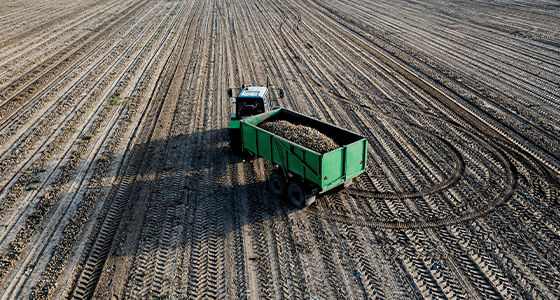
Across the U.S., planted fresh potato acreage is declining. A North American Potato Market News (NAMPN) report commissioned by the Michigan Potato Industry Commission is forecasting the smallest potato area for 2026 since 1952 — 74 years ago.
The report forecasts a 2.7% drop, or 24,000 acres, less than current 2025 estimates in 13 reporting states, with acreage reductions of 4.8 expected in California and Idaho.
The total national planted area for 2026 is estimated at 878,000 acres.
Potato growers are facing tough market conditions, rising production costs and regional water shortages. Adding to this is increasing competition at a global level — notably from China and India — and a lack of options when it comes to profitable replacement crops.
Another significant factor, the report found, is substantial volumes of potatoes in storage from the 2025 harvest.
The question facing growers: Is the data a genuine cause for concern or a necessary market adjustment in response to an oversupply and resulting low returns?
Forces at play
Sean Ellis, Idaho Farm Bureau director of publications, said the slide in acreage has been caused by several factors, but the biggest is likely low farm-level potato prices.
“The amount that potato farmers are getting right now is well below the cost of production,” he said.
Another significant contributing factor, Ellis said, is rising production costs.
“Input costs, for example, are not going down,” he said. “In many cases, what growers are getting for their product is down 30% to 40% over the last three years, and their costs of production are not budging.”
Limited supplies of water for irrigation is another factor in Idaho, along with parts of Oregon and Washington, Ellis said.
At the same time, he said growers have few viable alternative crops capable of replacing non-profitable potato acreage.
“Most years, there’s other crops you can turn to, whether it’s barley or beans in Idaho, or sugar beet, but right now there’s no other alternative crop you can make money from,” he said. “Pretty much everything’s under water.”
Ellis said increasing global competition, principally from China, is also affecting potato shipments to other markets.
“The amount of frozen potato shipments China is sending around the world has increased by something like 280% over the last four years,” he said.
Acreage versus yields
While the drop in acreage is attention-grabbing, it is worth noting that acreage and production yields are different things.
In fact, for many in the potato industry, the prospect of a drop in acreage is a positive development, with some hoping it will lead to a natural adjustment in prices.
“The acreage really is just a starting point; it doesn’t make a whole lot of difference,” Dale Lathim, Potato Growers of Washington executive director, said. “You’ve got to factor in the yield, what kind of weather we’re getting.
“It’s the production that counts, not the acres that are planted. Newer varieties are also yielding more.”
Lathim said a combination of factors including large crops requiring longer marketing is contributing to the acreage decline, but said potato consumption remains stable.
‘It’s a mature industry, so we’re not getting huge increases, but (consumption) continues to go up,” he said. “In terms of planted acres as growers, we’re trying to match up how much we plant to what can be marketed the next year so we’re not carrying over into another year.”
In Oregon, potato acreage has remained “pretty constant” statewide, said Oregon Potato Commission executive director Gary Roth.
“I think we’re about the same, maybe a little less,” he said.
Roth said access to water is always a concern, especially in the Columbia River Basin, which covers much of Oregon, Washington and Idaho, as well as parts of Montana and regions of Canada.
A dip in acreage without production change is “not a great thing for prices,” Ellis said, but indications are that the summer growing season is off to a good start, with the expectation that higher-than-average yields could offset any acreage decline.
“We may have the lowest potato acreage since 1952, but keep in mind our average yields are way higher than 1952, so we’re producing a lot more potatoes,” he said.
Ellis said some growers say acreage has to drop in 2026 to have a positive impact on market prices, which will continue to be affected by growing global competition.
“A lot of farmers I talk to are saying we need a big reduction in acreage this year — somewhere in the neighborhood of 20,000 to 30,000 acres,” he said.
“Whether potato farmers actually do that … we’ll see.”