

Shifting storage scence: Climate, supply chain, AI driving postharvest trends
Climate change, supply chain issues, increasing costs of construction materials and energy, and tightening regulations on refrigerants and chemicals such as sprout inhibitors are all factors influencing the decisions growers make about potato storage in today’s market.






Once a potato crop is harvested, the most important consideration for a grower is how and where it will be stored to keep it healthy on its way to market. And like everything else in agriculture, potato storage is ever-changing.
Climate change, supply chain issues, increasing costs of construction materials and energy, and tightening regulations on refrigerants and chemicals such as sprout inhibitors are all factors influencing the decisions growers make about potato storage in today’s market.
Increased environmental awareness is leading more growers to incorporate sustainability in the decision-making process. And as AI continues to advance, more growers are choosing to incorporate it and other technology not only into general farm operations but storage as well.
Companies that serve growers’ storage needs are responding to the trends, incorporating new materials and tweaking construction designs as well as developing new technology to streamline storage processes.
Change-driven details
Boise, Idaho-based McGowan Rice Construction is one of the companies working to both keep up with trends and meet customer demand, according to owner Mark Rice.
The full-service design/build firm works primarily in agricultural and industrial markets in the U.S., as well as Canada, Argentina and Mexico.
The biggest trend Rice is seeing in potato storage is the inclusion of more ventilation capacity in bulk storage units — a change driven by larger storage capacities, erratic weather and extended holding periods to accommodate year-round demand for potatoes.
“We treat every project as a unique design, and make sure we’re designing it with the grower and ventilation engineer in full collaboration with our design team,” Rice said. “We don’t treat any product as off-the-shelf storage.”
The increased ventilation demands have changed the way McGowan Rice designs both fan houses and air floors, resulting in storage facilities with more square footage.
There has also been an uptick in the use of crate and bin storage rather than loose bulk piles for potatoes in the past five years, Rice said. Growers have reported that crate and bin usage minimizes shrinkage, reduces pressure bruising and allows for better segregation of crops by variety or size.
“I probably priced a couple bin storage units in the last 20 years, and now we’re seeing five to 10 times the demand for them,” Rice said. “That’s been one of the biggest developments in storage — a dramatically different philosophy.”
Rice’s customers are also increasingly upgrading refrigeration systems in response to changing environmental laws regarding refrigerants, while sustainability concerns are driving a desire for effective insulation.
“When it comes to building structure, we’re paying more attention to insulation, making sure we provide an efficient and sustainable insulation product,” Rice said.
McGowan Rice primarily uses insulated metal panels that help with temperature and moisture control as well as thermal efficiency.
Climate considerations
Climate change has “both helped and hurt” McGowan Rice when it comes to building, Rice said. Traditionally, storage facility construction starts in the spring, with a target ready date of Sept. 1. Warmer temperatures are pushing the process to begin earlier in some areas.
“Frost is (occurring) in the northern climates somewhat sooner than it used to, so we are sometimes getting to start earlier in the year, even a month ahead of time,” Rice said.
Increased warming is also forcing some growers to move harvest dates back because of heat stress, with harvesting now starting around Sept. 15 in some regions. That occasionally gives McGowan Rice longer to complete building projects.
The biggest challenge facing McGowan Rice, as well as other construction companies handling storage, is supply chain issues leading to longer lead times on projects.
“From electrical to steel to concrete, it’s a longer lead time than 10 years ago,” Rice said. “Getting construction done in a timely manner is not what it used to be. We have to talk about projects six months earlier than we used to in order to have them ready when they need to be.”
Technology is also becoming a bigger factor in storage units, with variable frequency drives that regulate the speed of ventilation and cooling fans becoming standard on most new construction, Rice said.
More growers are also turning to technology that allows them to monitor stored crops from smart phones or laptops, and incorporating AI into storage management.
Evolving technology
One of the companies responding to the increased demand for tech in the storage sector is Greentronics, based in Ontario, Canada. Greentronics has been developing technology solutions for agriculture since 1994.
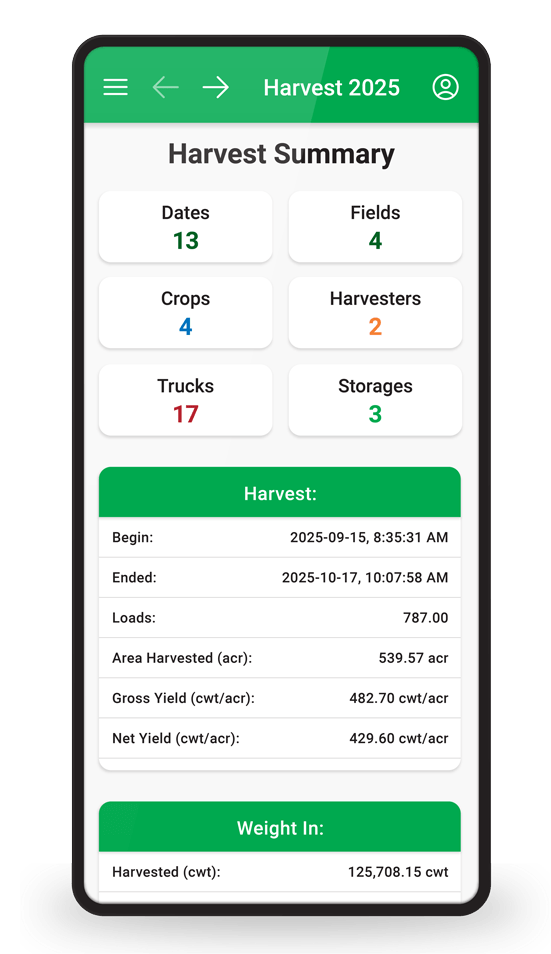
Cloud-based data storage makes it easier for growers to access storage data
rom anywhere, allowing crop monitoring in real time from a smartphone or tablet.
Photo courtesy of Greentronics.
Greentronics is currently launching RiteTrace Pro, an upgrade to its fully automated RiteTrace track-and-trace system. First introduced in 2017, the system allows growers to monitor potato crops from field to storage.
“The RiteTrace project started years ago when one of the potato growers near us challenged us to come up with a traceability solution that mapped the crop from the fields to storage and linked them together in a usable format,” Greentronics CEO Bill Menkveld said.
“Two of the downsides to the original Ritetrace were that it didn’t work well unless you had the complete system — the yield monitors, transponders, piler positioning and conveyor scales, and that it was not real time cloud-based,” Menkveld said.
Cloud-based data storage makes it easier for growers to access storage data from anywhere, allowing crop monitoring in real time from a smartphone or tablet.
“The new system is completely modular,” Menkveld said. “Not everyone has an immediate need for the entire system, but many are looking for convenient tracking and reporting.
“For example, an easy entry point is with just the conveyor scale. Many already have our scale, so this makes a great fit. You can get great storage maps and reports that way. (It’s) super helpful for tracking shipping operations and remaining inventories as well.”
The revamped system also allows a higher level of reporting and mapping that can be especially beneficial for storage management in large operations.
“It’s very convenient to be able to go online and see that storage bin X is half full, or 15% full,” Menkveld said. “A grower can judge how many more loads are needed from a particular field to top storage off, and track what went into storage when and what field it came from.
“That’s really convenient when it comes to shipping, so a grower knows which bin to start emptying first.”
By adding an infrared sensor on a harvester or piler, RiteTrace Pro allows growers to rapidly track and map crop temperature conditions of each field and storage. With real time monitoring, growers can make better decisions about storability and conditions at the storage facility itself, Menkveld said.
Greentronics can also install an infrared sensor on a harvester or piler so growers can track the temperature of a crop as it comes in.
“Temperature has a huge effect on storability. If (potatoes) come in hot, they need cooling,” Menkveld said. “It’s helpful to know your starting point. Growers can look at storage maps and know which layer came in at which temperature.”
Greentronics sells the RiteTrace Pro system through a dealer network, and the dealers handle installation, management and customer support. As RiteTrace Pro rolls out, users of the older system will be offered special pricing for upgrades, the company said.