

Biostimulants provide natural boost to potato production
Boosting yield while mitigating environmental stress sustainably is an ongoing concern across the potato industry, and biostimulants are promising emerging tools in that effort.






Boosting yield while mitigating environmental stress sustainably is an ongoing concern across the potato industry, and biostimulants are promising emerging tools in that effort.
Biostimulants are naturally derived substances or microorganisms applied directly to plants or the soil to stimulate natural processes. They can improve nutrient intake and use, crop efficiency, tolerance to abiotic stress — which is negative stress from environmental factors — and overall crop quality.
The most popular biostimulants include humic and fulvic acids, which form as natural compounds as organic matter decomposes; seaweed extracts; and beneficial bacteria and fungi. As of 2025, biostimulants were a $4.5 billion market in the U.S.
Growing potential
“Two things have led to the emergence of biostimulants: the desire to try using more natural or non-synthetic products and the emergence of recognition of crop loss due to increasing abiotic stress,” said David Hiltz, chief technical adviser with Agritein, a Louisiana-based company that produces the B4 line of biologically based fertilizers.
“We have a whole toolbox of different chemicals and products to treat diseases and pests, yet almost no tools in the toolbox to deal with abiotic stress, and that’s where biostimulants come in,” Hiltz said.
Hiltz has been working with plant biostimulants for almost 30 years. Before joining Agritein, he worked with Acadian Health in Nova Scotia, focusing on seaweed extract research and development. At Agritein, he works to increase grower awareness of biostimulants and advise regulatory agencies on how to handle them.
He calls Agritein’s B4 a “next-generation biostimulant” because it utilizes a substance that has been in use in agriculture for many years — seaweed extract — and combines it with new molecules and microbes. BF4 combines the extract from the seaweed Ascophyllum nodosum with a proprietary amino acid derivative and a microbial activator to create a multifaceted effect on plants, Hiltz said.
“You’re putting things together that will work together to help strengthen the plant,” Hiltz said. “What we’re hoping to see is a stimulation of the microbial community in the soil around that plant. A stimulation of soil bacteria can enhance the root growth in the potato, which then makes that plant able to better withstand stressors like cold or drought.
“The goal is to have the plant better primed to overcome periods of short-term stress.”
In 2024, several Agritein potato trials in Maine saw improved overall yields with BF4, Hiltz said. In 2025, the company worked with North Dakota State University on a trial that sought not only to improve yield but also reduce nitrogen input.
The two studies showed consistent increases in tuber count, gross yield and marketable yield, along with lower defect and reject levels. The improvements came with a modest reduction in nitrogen fertilizer use.
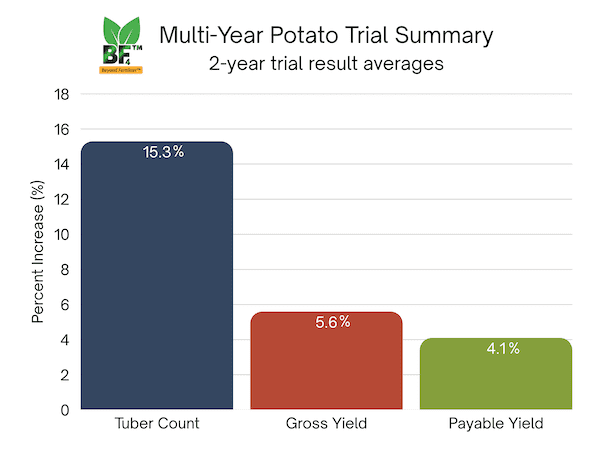
“We saw a net increase in overall crop yield even with a 15% to 20% decrease in nitrogen input, so we were able to maintain the yield and help the crop better use the nitrogen that was available,” Hiltz said.
Agritein is continuing studies with North Dakota State and is also working with private researchers in Idaho to study BF4’s effect on potato crops.
BF4 has been launched in the U.S., with registration pending in individual states, Hiltz said.
“Biostimulant registration is still very much emerging and kind of a work in progress,” Hiltz said. “Prior to this, a lot of companies would simply register products like this as a fertilizer, but we’re starting to transition from the old registrations to this new beneficial substance registration.”
Biological alternatives
Seaweed also plays a role in a new biostimulant y from California-based JH Biotech. Kelp Star, announced in January, is designed to boost crop performance within existing fertility programs.
Studies done by the company showed that applications of Kelp Star across the growing season resulted in a 58% increase in yield per plant. The product has also been shown to support canopy development and improve stress tolerance.
In early February, Massachusetts-based Kula Bio launched Kula-NSP and Kula-NextSP, two products that deliver nitrogen-fixing bacteria directly to the root zone of plants. They build on the platform established by the company’s original Kula-N, which has been approved as a certified biostimulant by The Fertilizer Institute.
Kula’s products use Xanthobacter autotrophicus, a nitrogen-fixing microbe known for its ability to store its own energy. Studies show that the microbe demonstrates up to 65% greater efficiency in nitrogen fixation compared to conventional nitrogen-fixing bacteria. When applied to the soil, the organism converts atmospheric nitrogen into forms directly available to the plant at the root zone, providing the plant with a steady uptake of nitrogen.
“Growers are under pressure to produce more with fewer inputs, tighter regulations and unpredictable markets,” said Geraldo Mattioli, chief commercial officer for Kula Bio. “Kula-NextSP and Kula-NSP give them a reliable biological alternative that performs in real-world conditions with cost competitiveness to fit their nitrogen programs.”
Another nitrogen-fixing biostimulant that has shown promising results on potato crops in Europe, the United Kingdom and North America is BlueN from Indianapolis-based Corteva Agriscience. It’s a biostimulant that better enables plants to capture nitrogen from the air and convert it into ammonium.
BlueN, applied directly to foliage, contains Methylobacterium symbioticum, a bacteria found in nature. It is sold as Utrisha N in North America.
Seed treatment applications
One emerging area is the use of biostimulants in seed treatments. The challenge with using biostimulants in seed treatment comes in applying the products in an effective amount to the seed itself, Hiltz said.
Companies are conducting trials on biostimulants seed treatments across a range of crops, including potatoes. Corteva produces Ympact, a seed treatment designed to enhance early plant growth and stress tolerance in crops including potatoes.
The product has shown positive results in cereal crops in the United Kingdom, Ireland and across Europe, and researchers are evaluating its effectiveness in other crops like potatoes, the company said.
Ympact contains humic and fulvic acids bonded with key micronutrients such as zinc, copper and manganese that are important for plant development.
In July 2025, Corteva introduced Lumidapt Valta LS, a seed stimulant for corn. Both products are derived from purified lignin extracted from pine trees, a byproduct of the paper milling industry.