

Balancing the backbone of crop nutrition
Getting nitrogen application rates right is critical in potato production. Global crop nutrition company Yara’s incubator farm in Idaho’s Snake River Valley helps fine-tune that delivery.





Nitrogen delivery crucial to development, yield and return on investment
Nitrogen is fundamental in every stage of crop fertilization and nutrient management. Administered early, it helps build a robust canopy, ensuring optimal carbohydrate production in leaves. As the potato crop grows, nitrogen helps maintain the greenness of the canopy and maximize yield.
As vital as the element is, getting its application rates right is equally crucial. Too much nitrogen too soon can cause excessive vegetative growth and restrict tuber formation. Overapplication may also reduce starch content, reducing processing potato crop quality, while an excess of the element as the crop matures may also reduce dry matter content, affecting quality.
With all these fluctuating factors at play, it’s no wonder that research into the correct balance of nitrogen and other crucial nutrients such as calcium remains a potato industry focal point.
The root of nitrogen delivery
Nitrogen is delivered to crops as nitrate, a compound derived from atmospheric nitrogen through natural processes like fixation or decomposition, containing one nitrogen atom bonded to three oxygen atoms. Nitrate-nitrogen, or nitrate-N, refers to the nitrogen portion of the total nitrate in a sample.
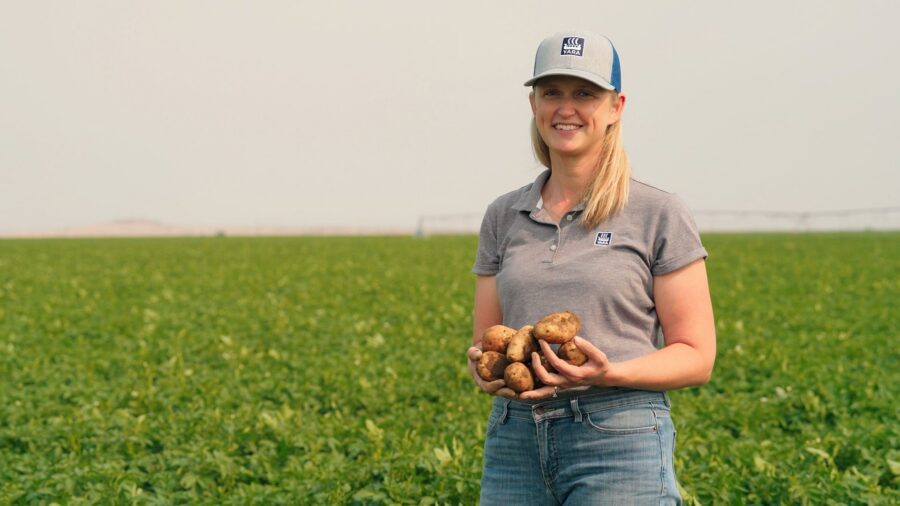
Global crop nutrition company Yara takes a hands-on approach to fine-tuning that delivery through its incubator farm in Idaho’s Snake River Valley, which produced its second crop in 2025 after two growing seasons in Washington’s Columbia River Basin.
“The goal of these farms is to understand and demonstrate the value of the Yara crop nutrition program on producing potatoes with the best marketable yield and quality and storage quality, and also to understand how we can help growers impact different sustainability metrics that are important across the value chain, like greenhouse gas emissions or nitrogen use efficiency,” Erika Wagner, Yara North America Climate Choice business development manager, told Spudman.
In both Idaho seasons, the incubator plots on commercial farms featured a split pivot of Burbanks for fry processing. The grower standard crop nutrition program was applied to half of the pivot, and Yara’s crop nutrition program was applied to the other half, Wagner said.
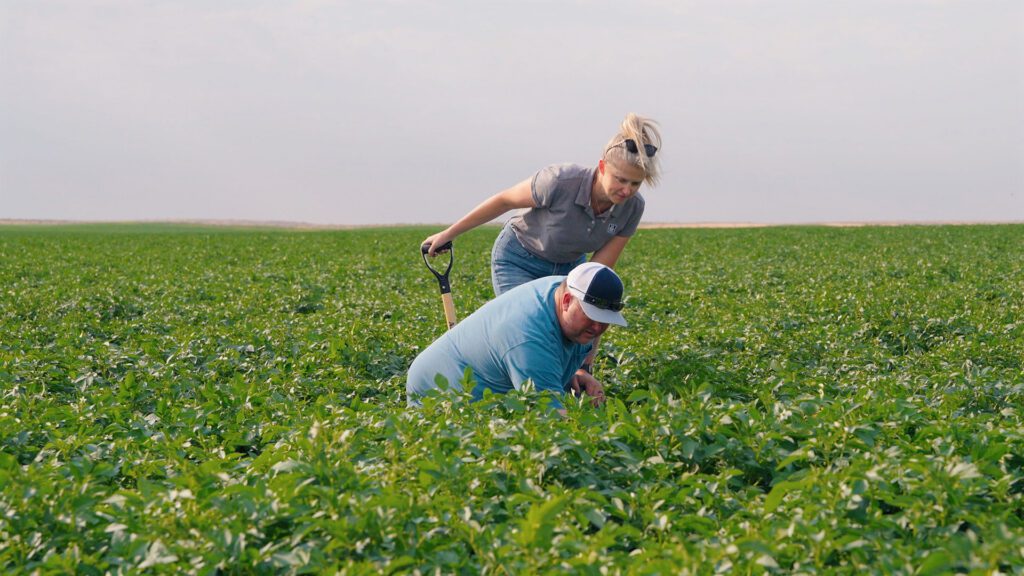
Yara’s incubator farm in Idaho’s Snake
River Valley produced its second crop
of potatoes for fry processing in 2025
after two growing seasons in the
Columbia River Basin in Washington.
Photos courtesy of Yara.
The program includes Yara’s range of calcium nitrate fertilizers, called YaraLiva, which provides nitrate-N alongside strength-building calcium — specifically YaraLiva CN-9, a liquid calcium nitrate fertilizer that delivers nitrate-N and soluble calcium. The fertilizer is fertigated through the pivot at tuber initiation, Wagner said, while UAN, a liquid fertilizer containing three forms of nitrogen (urea, ammonium-N and nitrate-N) is also applied directly to plants through irrigation.
“We also have a complete foliar nutrition package we apply based on crop needs at different growth stages but also based on any needs we detect, because we do tissue and soil sampling throughout the growing season to understand if the crop needs any nutrition and also to help us really narrow in those nitrogen rates,” Wagner said.
After careful in-season monitoring, harvest presents an opportunity to analyze yield and overall quality before the potatoes go into storage. When the spuds emerge from storage, processing quality can be gauged as part of an overall measurement of return on investment (ROI).
The two seasons in Idaho have produced striking results.
“In 2024, we were able to put out 19% less total nitrogen and have about the same yield,” Wagner said. “In 2025, which was a really long season conducive to good yields and very little stress, we put out 10% less fertigated nitrogen, and we had 4% higher yield at harvest in the Yara treatment.”
In addition, she said, nitrogen use efficiency improved by 11% in 2024, with lower-reducing sugars and better fry color observed in both 2024 and 2025.
Storage results in 2024 were inconclusive, as rain during harvest meant the two incubator halves were not stored together, Wagner said. However, analysis of extra samples stored at the University of Idaho did show better fry color with the Yara treatment.
In two growing seasons of Clearwaters for fry processing in Washington, Yara’s incubator farm produced a positive ROI in 100% of fields, with an average return of $139 per acre, Wagner said.
“That really came from the quality coming out of storage going to the processor,” she said. ”That’s what we’re hoping to see here in Idaho.”
Crop nutrition in the bigger picture
While Wagner emphasized that “crop nutrition is not a one-size-fits-all solution,” she said Yara’s results from Washington and Idaho hold widespread promise.
“We do this really intensely on our incubator farm where we pull a lot of data, but we also work with growers across North America to implement similar split pivots to look at different varieties and different types of potatoes,” she said. “I feel quite confident that our program significantly impacts nutrient use efficiency. But what that program looks like is going to be different for every grower and region and variety.”
Wagner, recently elected vice chair of the Potato Sustainability Alliance’s executive committee, oversees Yara’s Climate Choice fertilizer line, which aims to reduce greenhouse emissions both at the point of manufacture and for growers.
“We’ve invested a lot in making sure, historically, that our fertilizers are produced with low greenhouse gas emissions, and we’re investing more to reduce those emissions even more,” she said, through initiatives such as carbon capture and storage.
“In 2025, we were able to reduce the greenhouse gas emissions of the fertilizer program for a hundredweight of potatoes by 20%, so that’s really exciting, and that’s just using our normal fertilizer,” Wagner said. “So if we were using the Climate Choice fertilizer, that would be even lower. And then in 2024, we were able to reduce the greenhouse gas emissions for a hundredweight by 22.7%. That’s pretty significant with just changing the crop nutrition program.
“That’s another thing we’re hoping to be able to do, is partner with growers to understand ways we can practically reduce those emissions to help the value chain in a way that’s still producing the best crop possible for the user.”
Wagner, who has worked in agronomy for 14 years and with Yara for five, points to the increasing role of the company’s biological products, including its Yara Amplix biostimulant line, as sustainable advances the industry is digging into.
“I think there are some really useful technologies out there, and it’s just about understanding where or when they’re most effective so growers can have more tools in their toolbox, because they do have a lot of stresses they’re dealing with,” she said.
Improving crop performance, boosting growers’ bottom lines and achieving sustainability goals all start with formulating the best crop nutrition plan possible, Wagner said.
“Right now, there are a lot of pressures on the value chain to meet certain sustainability requirements, like reduced greenhouse gas emissions or reduced fertilizer rates or improved water use efficiency,” she said. “Maybe this is a broad brush, but historically, crop nutrition has been about producing as much as possible, not necessarily optimizing. We’re thinking a lot more now about making sure that what’s put out is being taken up by the crop, and we’re thinking about what our nutrition loss pathways are and trying to mitigate those.
“That helps for sustainability, but it also helps the growers’ bottom line, because any nutrition you’re paying to put out and it’s not being used by the crop is not going to help in terms of ROI.”