

$500 Per Acre: The Real Costs of Potato Nematodes in the U.S.





What growers risk by waiting for an outbreak
By Philip Watson, Ph.D., Professor of Agricultural Economics, University of Idaho, PAPAS Project Co-Director

(Sponsored) Potato growers rely on solid economic data when making nematode management decisions. As part of the PAPAS project, our researchers study how nematode outbreaks and their management costs impact grower profitability and the broader economy.
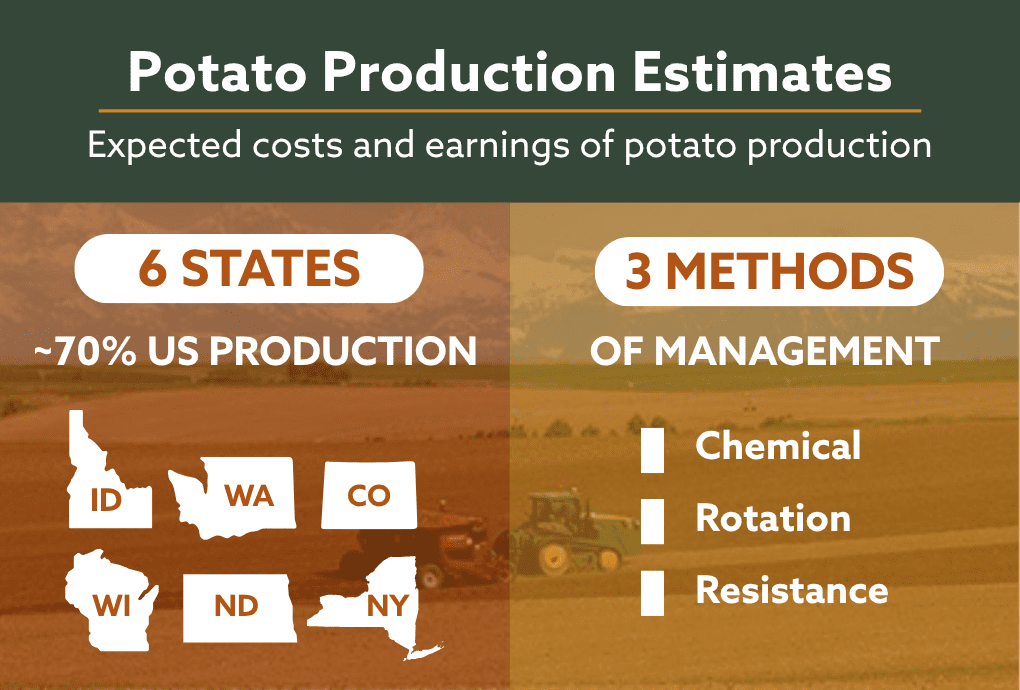
Through economic modeling, we estimated total production costs and earnings for six states representing more than 70% of total U.S. potato production. Then, we evaluated the financial impact of three different nematode management methods: chemical application, crop rotation, and nematode-resistant varieties.
Nematode control costs a grower $500 to $700 per acre
About $400 in additional chemical costs and $50 to $100 in increased harvest, storage, application, and operating costs.
Nematodes reduce farmgate revenues by $332K to $570K per 100 acres
Fumigation can produce yield gains that partially offset higher input expenses, but the margin remains thin in high-cost regions.
Rotating to alternative crops costs $290K to $500K per 100 acres
Planting alternative crops will partially offset losses, but returns fall short of what potatoes would have generated.
Potato nematodes cost the economy $668K to $1.8M per 100 acres
Factors in direct farmgate losses and farm household income, as well as broader disruption throughout the supply chain.
How To Prevent Losses from Potato Nematodes
Prevention is more cost-efficient than trying to control an established nematode population. Use certified nematode-free seed potatoes and clean equipment after moving from infested fields. An effective nematode soil sampling program is key to safeguard crops. Knowing the species present and their population levels helps identify threats early and make more targeted management decisions.
Nematode-resistant varieties are one of the most economically sound management measures, reducing input costs and boosting yields. While options are currently limited for U.S. growers, the PAPAS team is developing new commercially acceptable potato varieties with nematode resistance for more tools in the long run.
Read the full summary of our economic research and explore the latest nematode management resources at PotatoNematodes.org.
This work is supported by the USDA National Institute of Food and Agriculture (NIFA) award number 2022-51181-38450.
© 2026 PAPAS