

2026 Spudwoman of the Year Nicole Nichol drives variety development, industry improvement
2026 Spudwoman of the Year Nicole Nichol spearheads McCain’s varietal development as the potato processing giant’s director of ag, variety development and seed supply for North America.





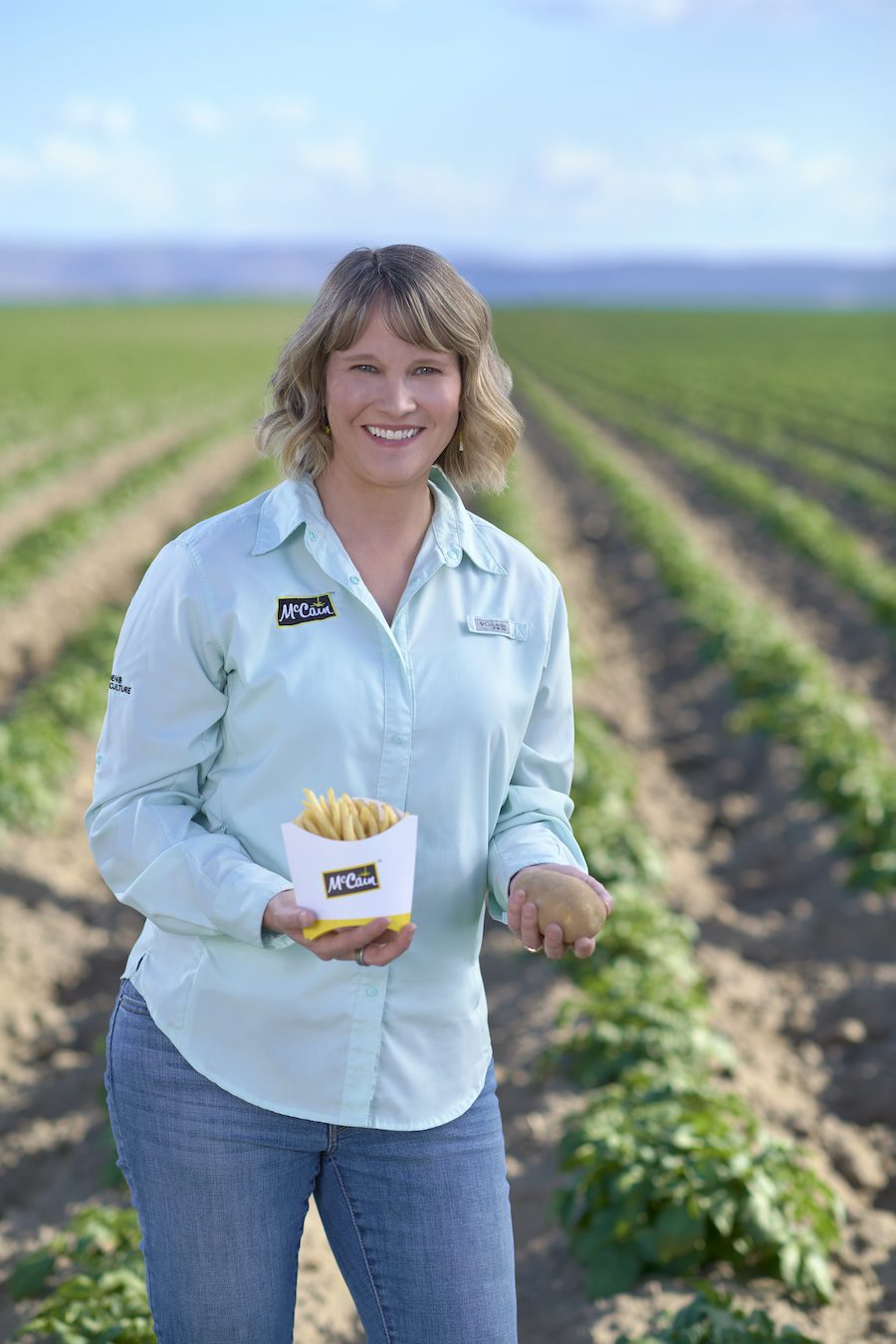
Most career fields have a Holy Grail of achievement — tenure for professors, a Nobel Prize for scientists, a Pulitzer for journalists.
The equivalent for those who work to develop new varieties of processing potatoes is approval by a global quick service restaurant (QSR) like McDonald’s, among others. Acceptance of a new variety can dramatically shift the production landscape for growers and drive the industry toward greater sustainability.
Receiving such news is the culmination of years of work. Nicole Nichol has experienced that feeling no less than 20 times.
Nichol, who spearheads McCain’s varietal development as the potato processing giant’s director of ag, variety development and seed supply for North America, has dedicated her career to finding new varieties with better yield and consistent processing traits while educating stakeholders about why new varieties are needed. Her efforts — and resounding success — have earned her recognition as Spudman’s 2026 Spudwoman of the Year.
Variety development at McCain is fundamentally about long-term crop and food system resilience, the company said. As climate conditions become more variable, developing potato varieties that can better withstand challenges like heat, drought, disease pressure and shifting growing conditions is critical to helping protect farmer yields, crop quality and farm profitability over time. This work is focused on supporting a more resilient agricultural system and helping ensure farmers can continue producing reliable crops in increasingly unpredictable environments.
“We’ve had some great wins, and Nicole has been a big part of that,” said Daniel Metheringham, McCain vice president of agriculture and sustainability. “She creates the buzz.”
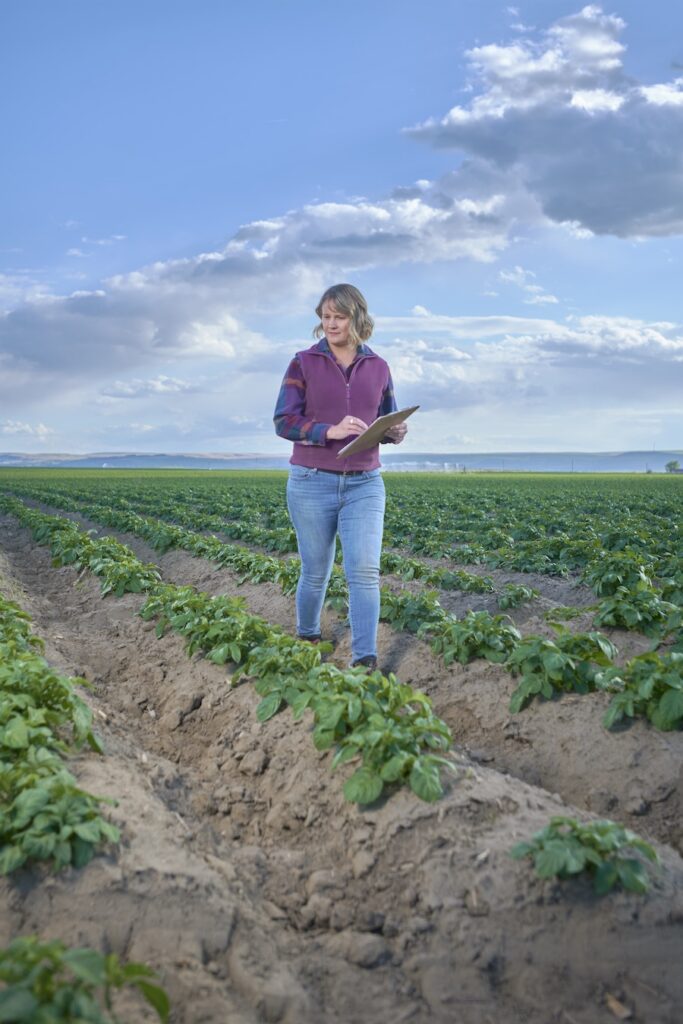
Nichol has helped develop numerous varieties given final or preliminary approval. The approval process requires years spent identifying a variety with QSR potential, followed by planting, harvesting and sample evaluation. Photo by Barry Coon/Commercial Photographers Inc.
Navigating a challenging road
Nichol’s latest triumph came in April, when Dakota Russet and Caribou Russet varieties she worked on were given the go-ahead for production at McCain.
Acceptance confirmation is “a red-letter day,” Nichol said. “It’s very exciting. It’s really great talking to the breeders, to be able to go back to the breeder and tell them that they’ve had a good sample, and then when it is approved, that’s a big day for them. That’s what they were working towards.”
For decades, Russet Burbank has been the processing industry stalwart. Breeding programs around the country and the world are constantly on the hunt for new varieties that use inputs such as nitrogen more efficiently while demonstrating greater disease resistance to reduce input costs and bolster sustainability.
A QSR nod is crucial for promising new varieties to achieve widespread planting and an eventual starring role in those efforts.
“Internally, there’s just so much to work on all the time, from the very beginning at managing the seed,” said Nichol, who saw the Teton Russet variety approved by key customers.
Years spent identifying a variety with QSR potential, followed by planting, harvesting and sample evaluation, is a painstaking process, and “it can be a few years between that first sample that scores well until you get through all the other hurdles,” Nichol said.
Some customers approve each production plant individually, so “for each new variety, you’ve then got to go work on any other facility that you want to use that variety,” she said.
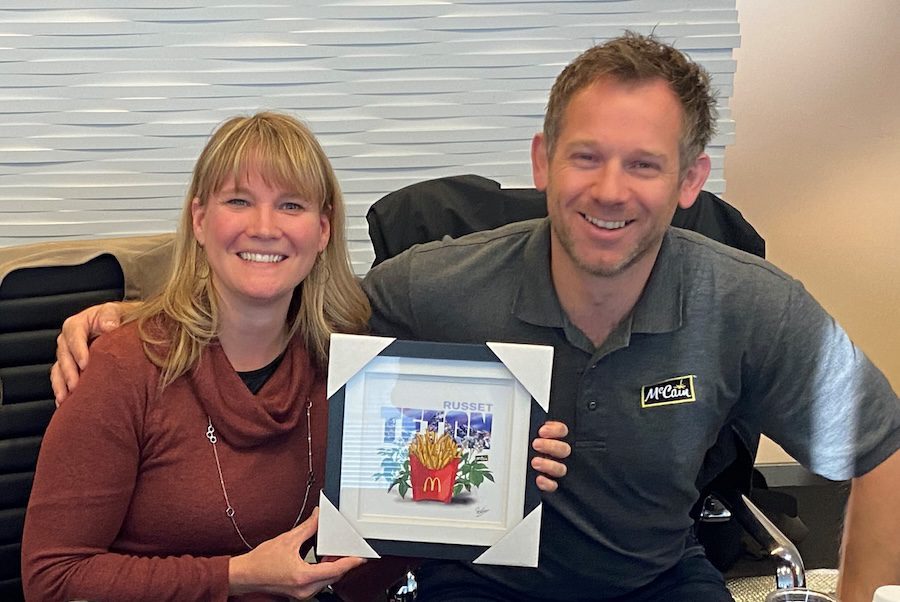
At McCain, Nichol works with vice president of agriculture and sustainability Daniel Metheringham to oversee development of new varieties of processing potatoes for approval by quick service restaurants (QSRs) such as McDonald’s and others. Photo courtesy of Nicole Nichol.
Metheringham said successful varietal development has three main pillars.
“The first thing we’ve got to do is be able to grow the variety. That’s not an easy feat,” he said. “The second piece, which is a huge lift, is the manufacturing. We’ve got to be able to turn it into a french fry. So we find the variety in the field that works and works well for the grower. Then we have to be able to process it and learn how to process that variety.
“And then finally, the third one is consumer acceptance, (which) you don’t get until the very end, but it’s probably the most important. If you don’t have consumer acceptance, you’ve not got the sale at the end.
“The world that Nicole lives in is working with the growers at the early stage of manufacturing, and then the customer at the end, and she does a great job in engaging with the major customers in North America.”
Nichol’s interest in variety development was piqued during graduate studies at Michigan State University (MSU). Working in renowned potato breeder David Douches’ lab, Nichol began delving into potato genetics. In that pursuit, she helped conduct field trials for J.R. Simplot, where she would eventually spend seven and a half years in a career arc that also included a stint at Lamb Weston.
“Even with all of the more advanced tools that we have today, in terms of having a better understanding of the performance of different potato varieties (and) genetics, there still is a lot of the art and the science of potato breeding and variety development,” said Joe Coombs, a long-time assistant researcher and breeder at MSU. “It’s really getting to know potato varieties like you know people.
“(Nichol) was able to have that experience here, and it was a good, positive experience, and really kind of launched her on that career path. … It is really important to the potato industry to have impactful people like that (who) continue to bring their experience and expertise with them.”
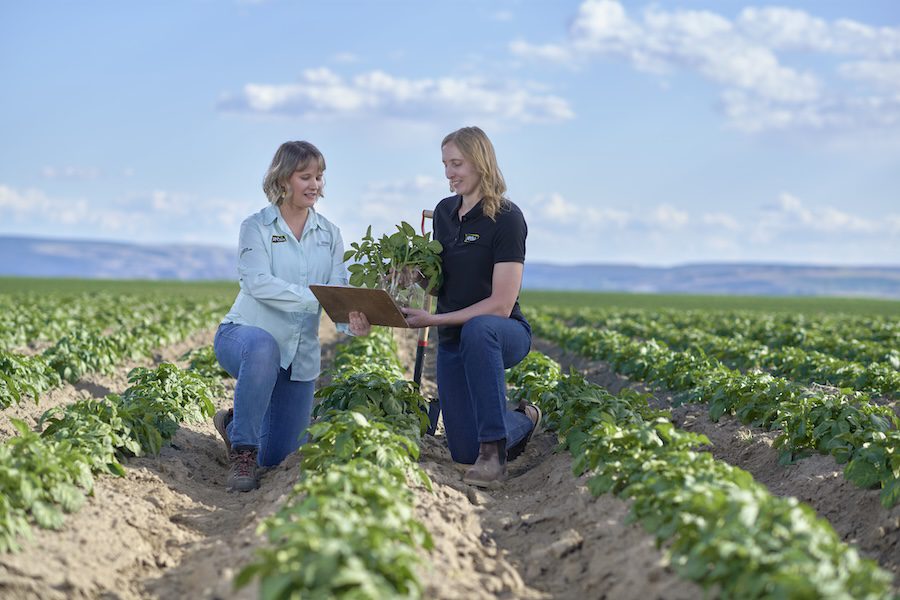
Nichol and Athena Gates, McCain field manager for the Washington region, analyze an early crop. Photo by Barry Coon/Commercial Photographers Inc.
Motivation in community
Nichol’s potato expertise has combined with her go-getter personality to earn her colleagues’ admiration. At Simplot, she worked on Sharie Fitzpatrick’s regulatory compliance team, bringing enthusiasm to everything she did.
“I remember a project that was sort of dry and mundane, and she was able to approach it in a new way that people were enjoying the topic and really coming on board more quickly,” Fitzpatrick said. “Frankly, no one really digs compliance, but she developed a nice workshop, and people had a lot more fun with it.
“She listens and can understand where to meet people. (Variety development) is about improving potatoes but doing it in innovative ways, and sharing her enthusiasm gets a lot of people on board very quickly.”
Nichol, who has four children and a step-grandson, credited Fitzpatrick with modeling how to achieve work/life balance as a fellow working mother with corporate responsibilities including lots of travel.
“She had a young family and quite a lot of responsibility there, and I could relate, because early in my career, I was in the same shoes,” Fitzpatrick said. “I had people that supported me through it. I just retired, so back when I started, it was even more unusual for women to try to have a career in agriculture, to say nothing of being a young mother in agriculture. It takes a lot of support around you. (Nichol) understood where she needed to be.”
Metheringham has worked with Nichol, named to the Top 22 Influential Female Food & Beverage Leaders by the Food Manufacture podcast in March 2025, for five years.

Nicole Nichol with husband Kerwin Bradley and children Jack Nichol, 17, Keira Nichol, 14, Emmet Nichol, 12, Quinn Nichol, 9, and step-grandson, Kerwin Berenfeld, 3. Photo by Allison Maroun.
“It’s been exciting to see her grow, and the ambition grow,” he said. “From the first time I met her, you could tell she wants the whole industry to improve. She wants to look for ways she can help the growers through variety to be more profitable, more sustainable, to have more consistent yields, to be protected from disease.
“She is a potato nerd, that is for sure.”
While variety development is a laborious process, “I don’t think Nicole is patient,” Metheringham said with a laugh. “I think she wants it all now. That’s some of that drive. What she’s achieved with variety approvals, the large QSRs in North America, within our own portfolio, within McCain — it really is transformative.”
Nichol’s knack for siphoning success is also evident in outside-the-office roles that include umpiring her children’s baseball games, taking them flyfishing in their hometown of Boise, Idaho, and serving as her office’s Girl Scout cookie source.
“When I think I’m busy, I look at Nicole and what she achieves,” Metheringham said. “To manage that, as well as the amount of travel she has at work, as well as continue with that sort of passion — it’s unbelievable.
“I don’t live in Boise, Idaho, but I can tell she is that pillar of the community.”
A sense of community is what appealed to Nichol about the industry she’s made her career, going back to her days at MSU planting gardens in inner-city Detroit to foster food security.
“That definitely was at the core of why I wanted to go into this — to help feed the world,” she said. “At the end of the day, all the variety development work that we’re doing — it’s so that decades from now, we can still supply potatoes and we can have that assurance of our supply chain.”